Che emonzione! / Yay!
Help IWJ create more great free content!
-
Recent Blog Posts
Che emonzione! / Yay!
[Note: Any text in Italian is followed by the English translation.]
“Chiusa una porta si apre un portone.” Significa che quando perdi un’occasione c’è subito un’altra opportunità. Quindi, nella vita, siate ottimisti e fiduciosi!
This Italian idiomatic expression translates roughly as “Closed one door, a bigger door opens.” It means when you miss out on one chance, there will be another, perhaps better, opportunity soon after. The English equivalent is “When one door closes, another opens.” Therefore, be optimistic; trust life!
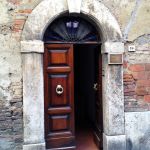
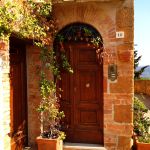
Ecco tre delle mie foto preferite di porte in Toscana. Chissà che si nasconde oltre la soglia… Riccamente ornate con le loro cornici di pietra, uno immagina che sia qualcosa di incantevole.
Here are three of my favorite photos of doors in Tuscany. Who knows what’s hidden beyond the entryways… Richly ornate in their stone frames, one imagines that it must be something lovely.
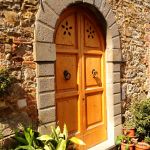

1. Sulla sinistra | On the left:
Porta di legno soleaggiata e circondata da piante a Greve in Chianti. | A sunny wooden door surrounded by plants in the town of Greve in Chianti.
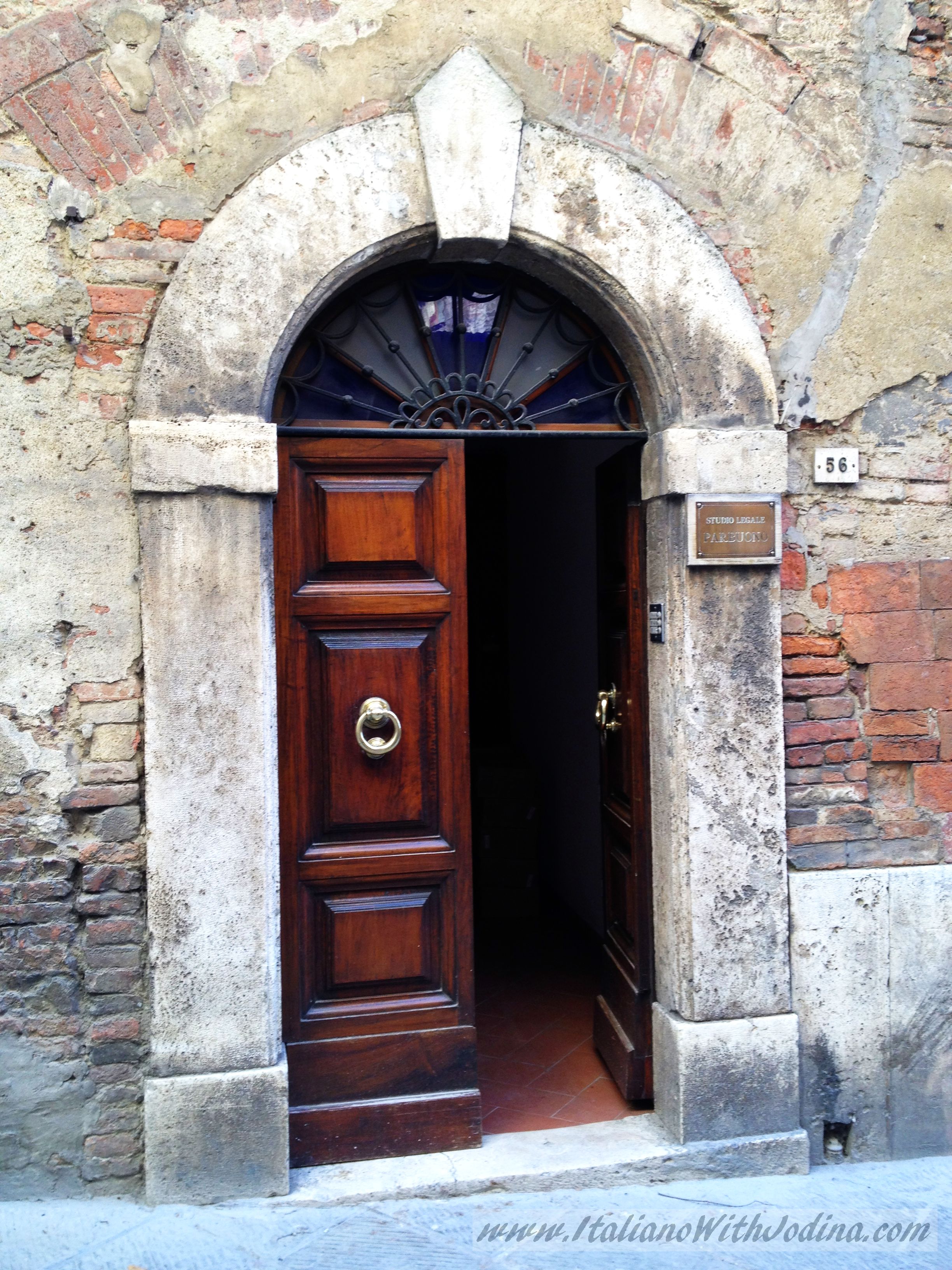
2. A destra | On the right:
Una vecchia porta a Montepulciano. Adoro la visuale dei vecchi mattoni, le crepe, e l’intonaco dei muri intorno. Notate il nome sulla targhetta a destra: Studio Legale Parbuono, traducibile approssimativamente come “uno studio legale che sembra buono”. | An old door in Montepulciano. I like how you can see all of the old bricks, cracks, and plaster on the walls around it. (The name plate to the right says Studio Legale Parbuono, which roughly translates to “Seems Good Legal Studio”. Lol!)
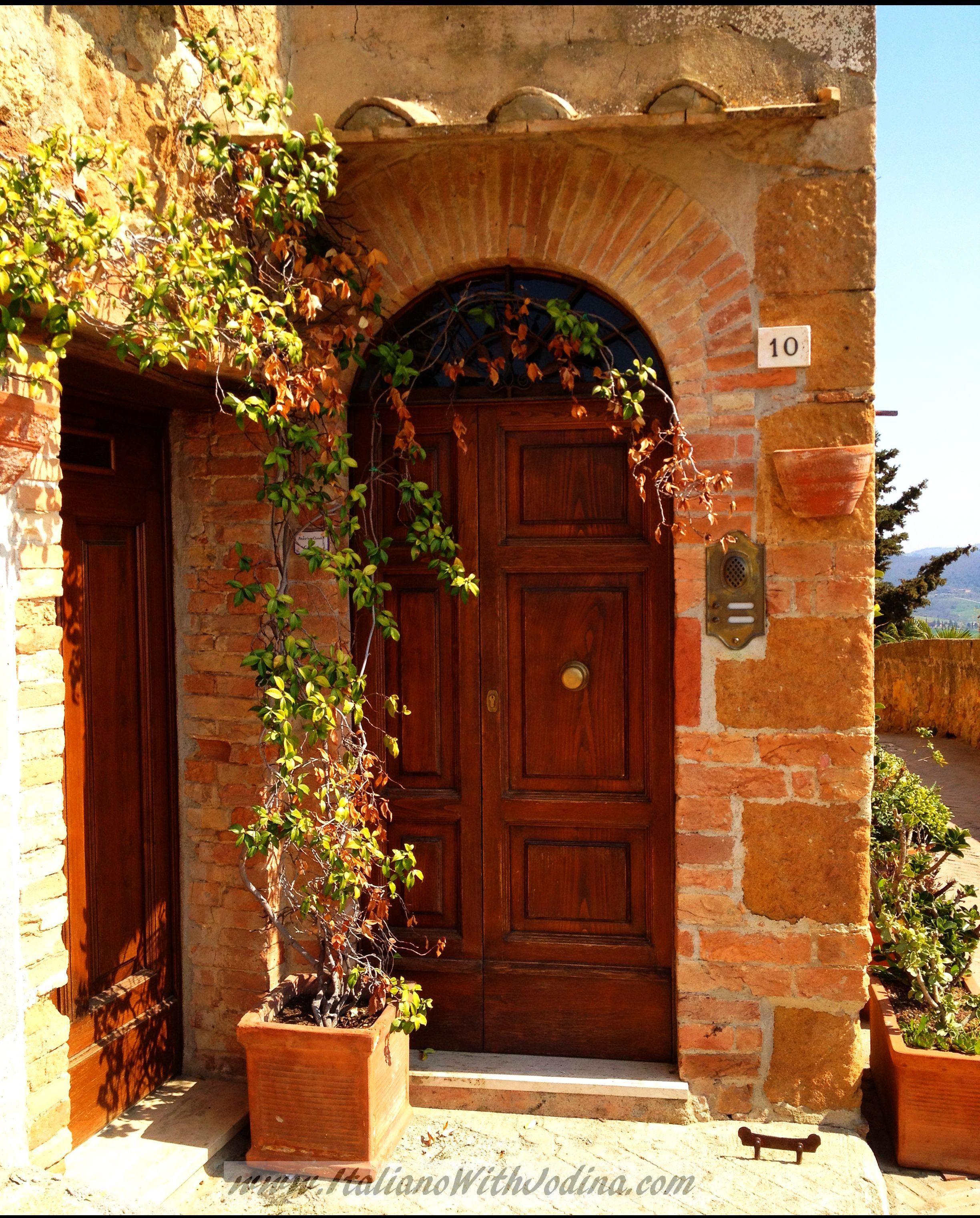
3. A sinistra | On the left:
Nº 10 di via della Fortuna a Montepulciano. Vorrei risiedere ad un indirizzo così speciale. C’è persino un vecchio ferro per pulire le scarpe! | No. 10 Fortune Street in Montepulciano. I’d like to live at such a special address. There’s even an old iron shoe cleaner!
[Grazie al mio collaboratore speciale, Lobsang Burzacchini]

Quale porta è la tua preferita? / Which door is your favorite? Sei ottimista? / Are you an optimist? Adoro leggere i vostri commenti! / I love to read your comments!
Questa settimana condivido tre parole preferite. | This week I am sharing three favorite words:
assaporare | passioni | apprezzare
savor | passions | appreciate
Permettetemi di contestualizzare. Questa settimana ho saputo che è venuta a mancare un’amica d’infanzia. Un tempo eravamo molto vicine, poi, traslochi di famiglia, scelte di vita differenti e soggiorni in paesi distanti, avevano creato molta distanza tra noi. Comunque sia, occuperà sempre uno spazio prezioso nel mio cuore e nella memoria dei ricordi.
Let me put those in context. This past week I learned of the passing of a childhood friend. At one time we were very close, but family moves, different life paths and far-away travels had put distance between us. All the same, she will always hold a cherished place in my heart and in my memories.
Ancora una volta l a vita mi ha ricordato di quanto può essere effimera. Era giovane, vivace e conduceva un’esistenza piena e significativa, finché un tumore non ha deciso di prendere residenza nel suo cervello. La notizia mi ha profondamente rattristato e ricordato che viviamo sempre di tempo preso in prestito e l’unica certezza è il momento presente.
Once again life reminded me of how fleeting it can be. She was young, vibrant and living a full and purposeful life, until a tumor decided to take up residence in her brain. The news saddened me greatly, and reminded me that we are always living on borrowed time, and that the only certainty is the present moment.
Sulla sponda opposta di tristezza e lacrime, la morte della mia amica mi ha ispirato ad onorare la sua memoria e rinnovare il mio voto a vivere pienamente.
On the other side of sadness and tears, my friend’s death has inspired me to honor her memory by renewing my vow to live life fully.
Ecco ancora quelle parole… parole di vita: | Here again those words… words to live by:
Asapora ogni giorno. | Savor each day.
Non rimandare l’inseguimento delle tue passioni. | Don’t put off following your passions.
Apprezza ciò che è bello e dì alle persone importanti nella tua vita che le ami. | Appreciate what is good in life and tell the important people in your life that you love them.
In memoria di Jenny Behnke. | In memory of Jenny Behnke.
Fave Three Thursday is a new regular blog post that launches today! Each post will feature three of my favorite Italian things. They could be any three things… from three favorite photos to three favorite Italian words to three fave idiomatic expressions… Each post will be a small, bite-sized morsel of Italian language and culture — a quick shot of Italy that I hope adds a boost to your day.
We’re kicking off this new blog series with three of my favorite photos that I took of bicycles in Tuscany or, biciclette in Toscana.
Gradite! /Enjoy!
[Note: Any text in Italian is followed by the English translation.]
Adoro le biciclette…come mezzo di trasporto, modo di fare sport e ginnastica, come oggetti d’arte. Mi sembra di averne sempre posseduta una: la prima a cinque anni, una Huffy rosa, un’altra a dieci, una Schwinn celeste a 10 cambi (ultimo grido di quegli anni) e infine quella che mi accompagna ancora oggi giorno, una Raleigh color argento tipo ibrido, un incrocio tra due ruote da strada e Mountain-bike. Di seguito le mie foto preferite di alcune bici a Firenze.
I love bicycles… as a means of transport, a way to exercise, as objects of art. It seems to me that I have always had one: my first at five years old, a pink Huffy, another at 10, a sky blue Schwinn ten-speed (the latest greatest thing back then), and finally the one that accompanies me these days, a silver Raleigh hybrid, a cross between a street bike and a mountain bike. Here then are my favorite photos of bikes in Florence.
Gradite! /Enjoy!
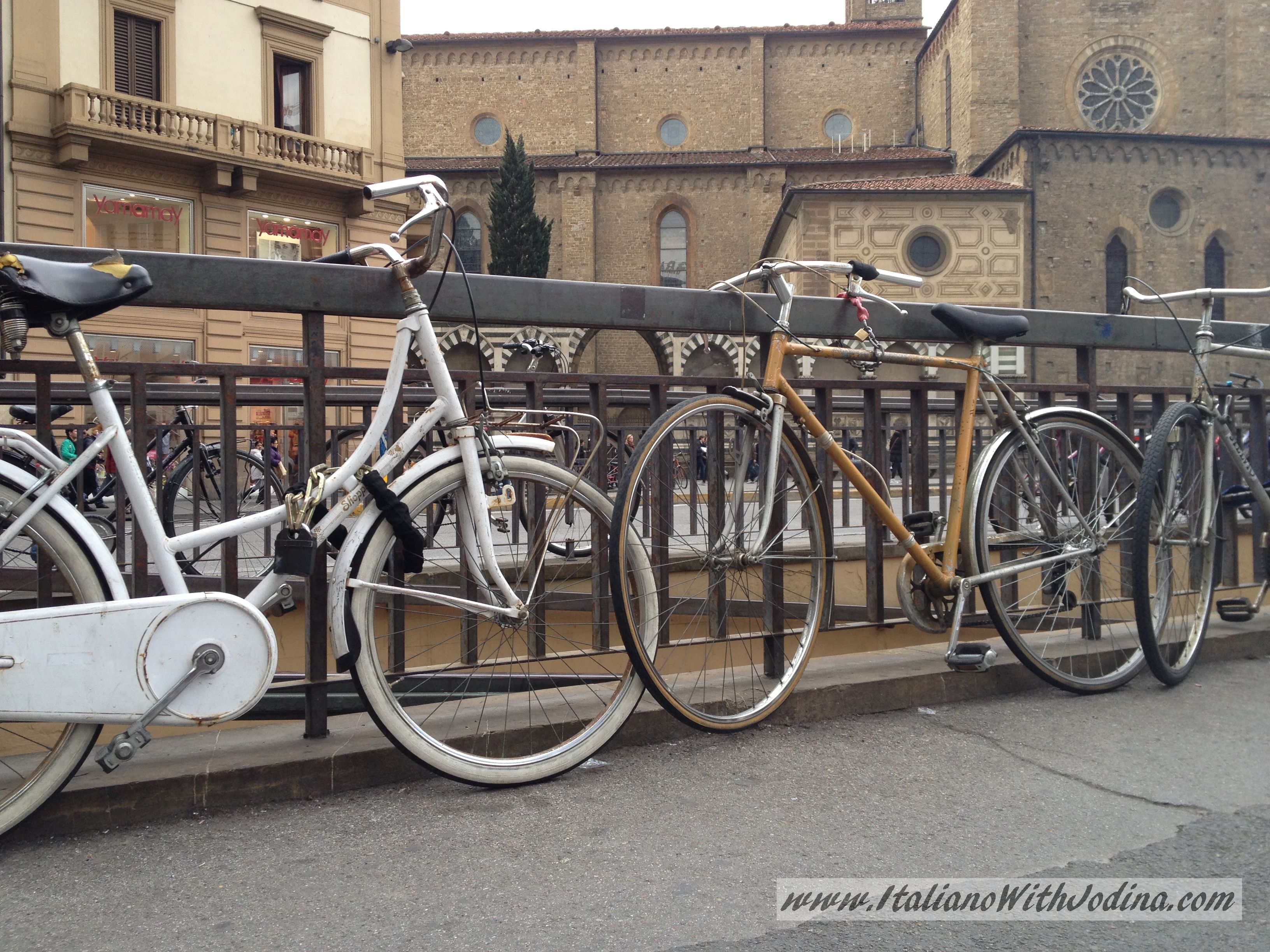
Bici parcheggiate davanti alla Chiesa Santa Maria delle Grazie di Firenze. /Bikes parked in front of the Santa Maria delle Grazie Church in Florence.
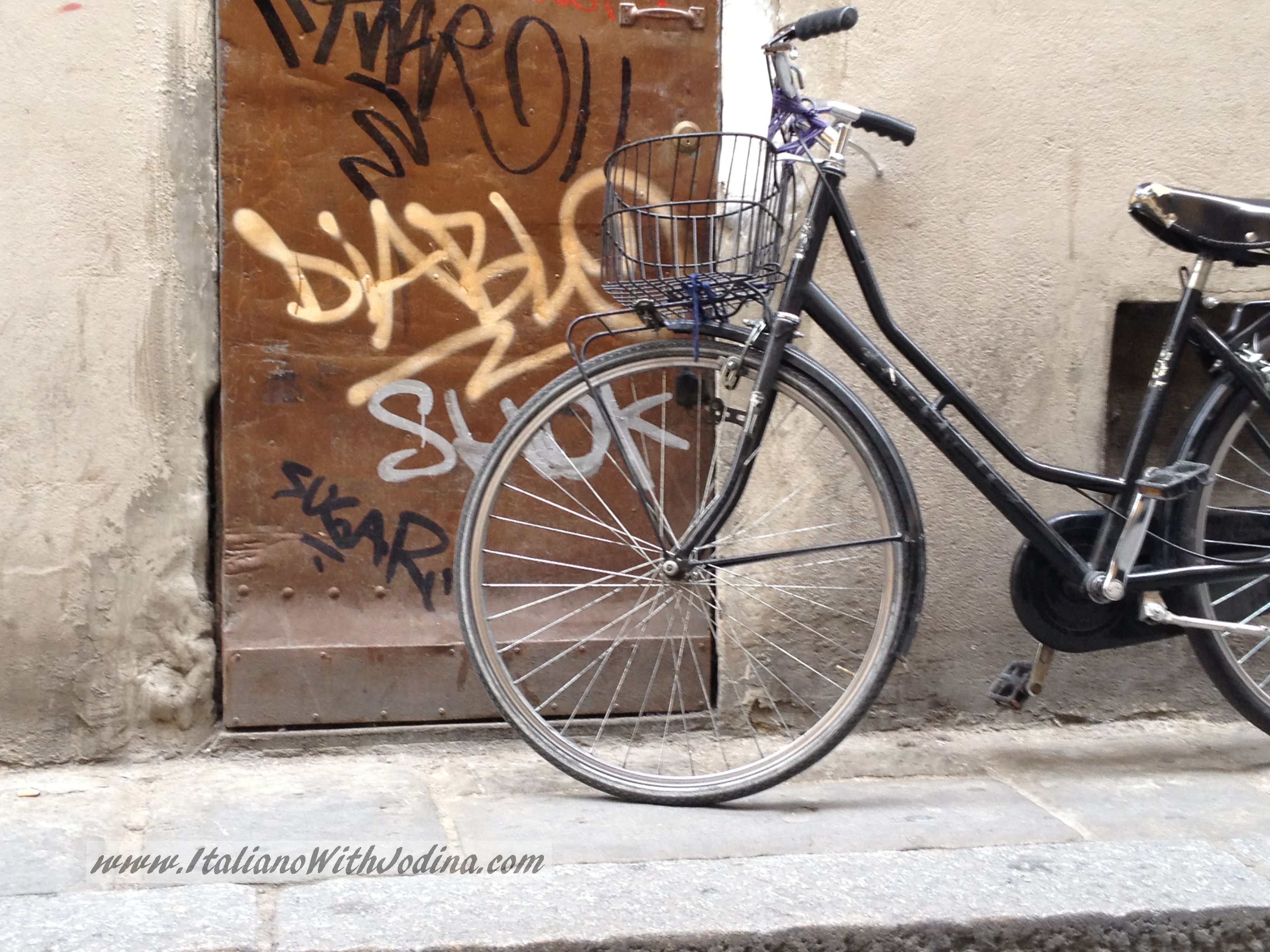 Una bicicletta nera da passeggio prova a confondersi tra i graffiti di una porta. / A black cruiser style bicycle tries to blend in with the graffiti on a door.
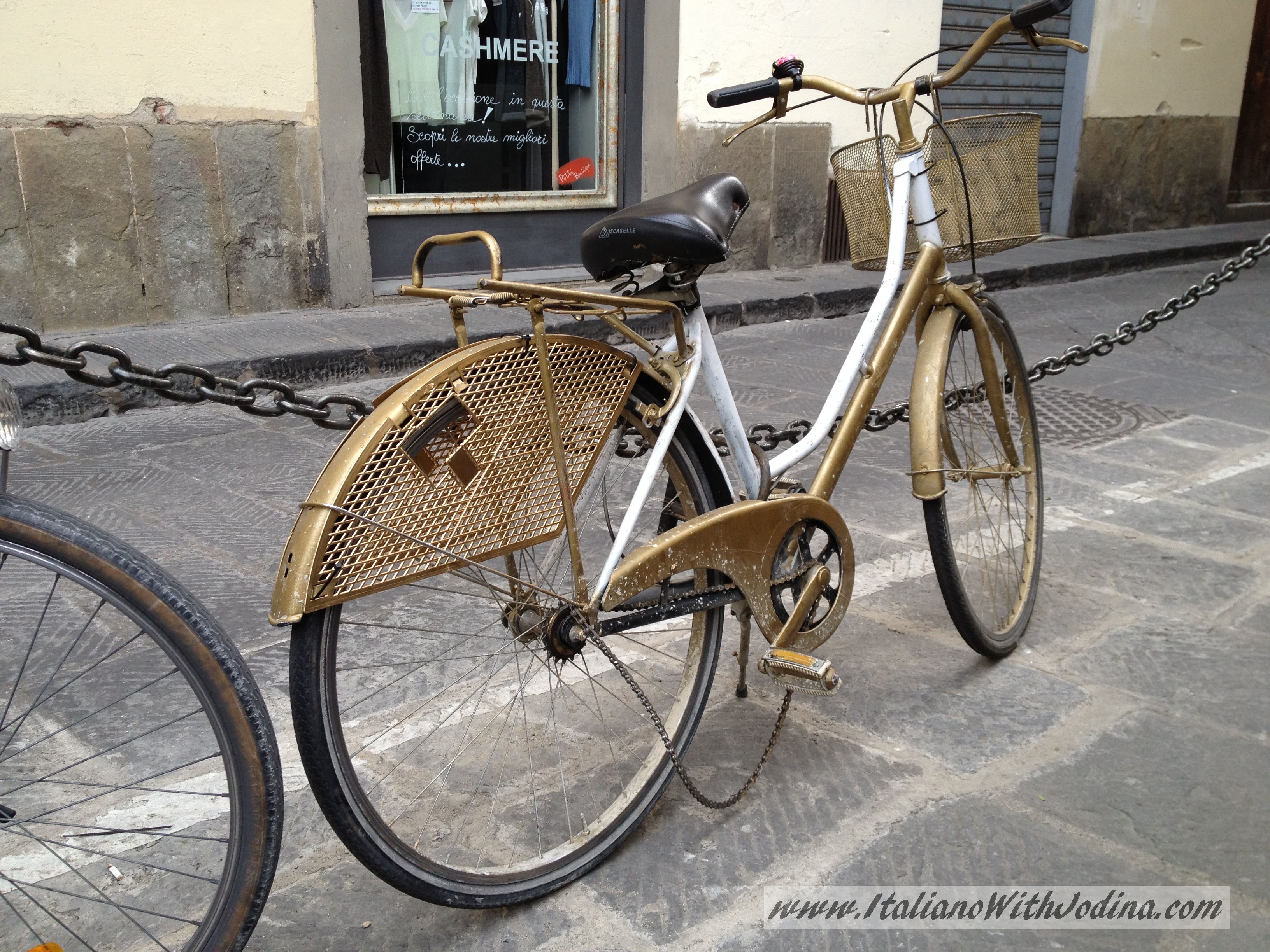 Preziosa come l’oro, ma con la catena vistosamente rotta… / Precious like gold, but with the chain visibly broken…
E voi? Siete appossionati delle bici? / And you? Are you a bike enthusiast?
 March 8th is International Women’s Day. This day is observed widely in many countries around the world. Oddly though, it is not observed in the United States. In fact, the first time I’d heard of it was shortly after I’d moved to Italy.
In italia la Festa della Donna si festeggia l’8 di marzo. | In Italy, Women’s day is celebrated on March 8th.
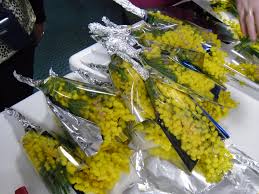
Mazze di mimose | Bouquets of mimosa flowers
Gli uomini regalano i fiori, solitamente le mimose, alle colleghe di lavoro e a tutte le altre donne importanti nelle loro vite… mamme, sorelle, fidanzate, ragazze, ecc. | Men give flowers, usually mimosas, to their female colleagues and to all the other important women in their lives… moms, sisters, fiances, girlfriends, etc.
Contrary to popular belief, the mimosa is not just a popular cocktail made from succo d’arancia (orange juice) and champagne, though I suspect this drink was inspired by the true mimosa.

La mimosa piu` famosa — the most famous mimosa: Mimosa Cocktails
The mimosa is the fragrant and fluffy yellow pom-pom-like flower of the acacia tree. California is full of these trees this time of year, as is Italy, which is why this flower is so common on this day. I love the smell of these flowers — their fragrance zooms me straight back to wonderful memories.
Below are a few Women’s Day auguri (greetings) to share with someone special:
 Women’s Day is a celebration of all that is wonderful about women, and it is a day to pause and reflect on the accomplishments and importance of the role of women in our world. It’s also a moment to consider improvements and changes needed to better the quality of women ‘s lives in general, and especially of women and girls whose rights and life conditions are extremely compromised or perilous.
Remember to give an extra hug or shout out to the women who matter in your life today. And remember also the women whose lives are not what they could be. We’ve come a long way baby, ma c’è ne ancora di strada da fare! (there’s still a ways to go!)
Have you heard of Women’s Day before? Do you celebrate it? Which mimosa do you prefer, the flower or the cocktail? 😉 Love your comments!
[NB: This post is in Italian interspersed with the English translation.]
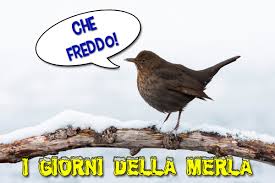 I giorni della merla sono il 29, 30, e 31 di gennaio. Secondo la leggenda, se questi giorni sono freddi la primavera sara` bella, e se sono caldi la primavera arrivera`tardi. Questo e` forse la cosa piu` vicina nel folclore italiano all’osservanza di Groundhog Day (2 febbraio) negli Stati Uniti, secondo la quale, se la marmotta (the groundhog) vede la sua ombra, l’inverno durera` altre sei settimane. Se invece non vede l’ombra la primavera e` in arrivo.
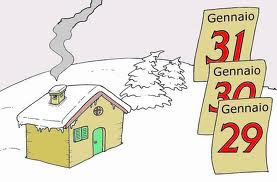 The days of the blackbird are the 29th, 30th and 31st of January. According to the legend, if these days are cold, spring will be nice/ beautiful, and if they are warm, spring will arrive late. This is perhaps the closest thing in Italian folklore to the observance of Groundhog Day (February 2nd) in the United States, according to which, if the groundhog sees its shadow, winter will last another six weeks. If instead it doesn’t see its shadow, spring is on the way.
 La leggenda dei giorni della merla ha le sue radici nei tempi romani quando nel calendario il mese di gennaio ancora conteneva solo 28 giorni. Secondo la storia, una merla, con uno splendido candido piumaggio, era regolarmente strapazzata da gennaio, mese freddo e ombroso, che si divertiva ad aspettare che lei uscisse dal nido in cerca di cibo, per gettare sulla terra freddo e gelo.
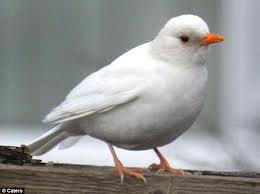 The legend of the days of the blackbird has its roots in Roman times when in the calendar the month of January still only contained 28 days. According to the story, a blackbird, with her splendid, snow white plumage mistreated/overwrought by January, a cold and overcast month, who amused himself by waiting for her to leave her nest in search of food, and then casting bitter cold and frost onto the Earth.
 Stanca delle continue persecuzioni, la merla un anno decise di fare provviste sufficienti per un mese, e si rinchiuse nella sua tana, al riparo, per tutto il mese di gennaio, che allora aveva solo ventotto giorni. L’ultimo giorno del mese, la merla, pensando di aver ingannato il cattivo gennaio, uscì dal nascondiglio e si mise a cantare per sbeffeggiarlo.
Tired of the ongoing harassment, one year the blackbird decided to gather enough provisions for a month and closed herself in her nest-lair, taking refuge for the entire month of January, which at the time had only 28 days. The last day of the month, thinking to have outsmarted the wicked January, she left her hideaway and started singing to mock him.
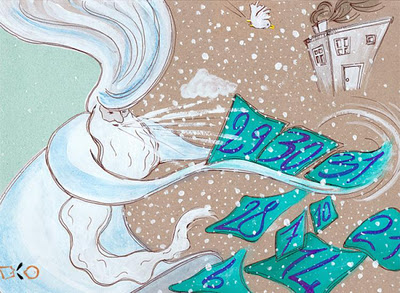 Gennaio se ne risentì così tanto che chiese in prestito tre giorni a febbraio (che allora aveva ancora 31 giorni) e si scatenò con bufere di neve, vento, gelo, e pioggia. La merla si rifugiò in un camino e lì restò al riparo per tre giorni. Quando la merla uscì, era sì salva, ma il suo bel piumaggio si era annerito a causa del fumo e del fuliggine, e malgrado cercava di ripulirsi non ci riusciva.
January took such great offence that he asked February (which then still had 31 days) for a loan of three days, and he let rip with snow storms, wind, ice, and rain. The blackbird 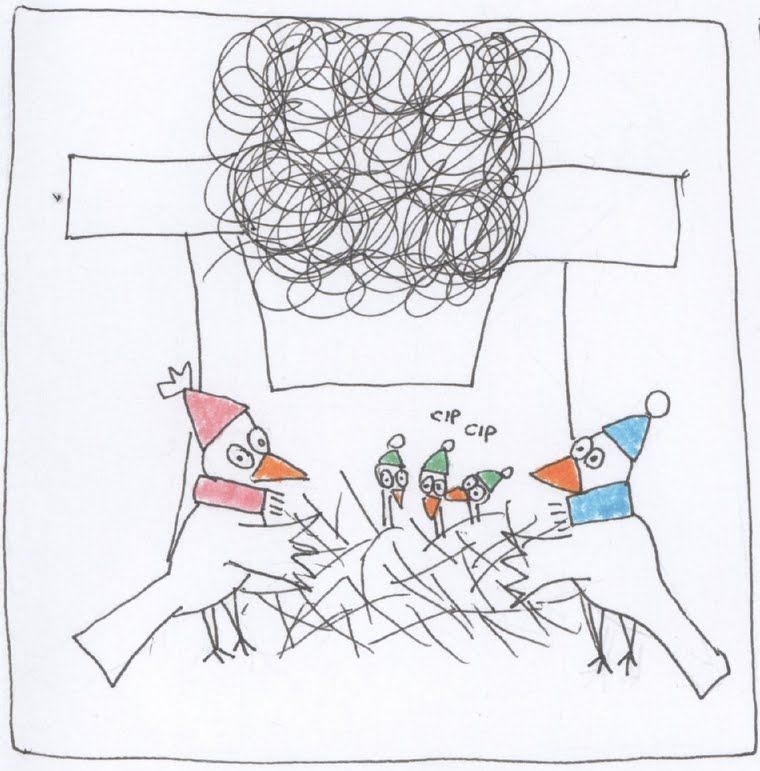 took shelter in a chimney and there she stayed sheltered for three days. When the blackbird came out, she was indeed safe, but her beautiful plumage had blackened from the smoke and soot, and despite her efforts to clean herself up, she wasn’t able.
Il potente gennaio si godette la scena e poi disse con il suo vocione: “Che questo serva da lezione a voi e a tutti gli animali: non si scherza con le stagioni, con il freddo o con il clima. Non ci si può prendere gioco della Natura. Da oggi in poi io (gennaio) avrò 31 giorni e gli ultimi tre giorni saranno i più freddi dell’anno. Per ricordare a tutti questa storia, i merli porteranno per sempre queste 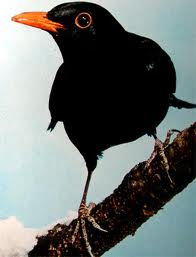 piume nere”.
Powerful January was amused by the scene, and then he said in his thundering voice “ Let this serve as a lesson to you and to all the animals: You don’t joke with the seasons, with the cold or with the climate. You cannot make fun of/trifle with Nature. From today forward, I (January) will have 31 days, and the last three will be the coldest of the year. To remind everyone of this story, the merli (blackbirds) will forever more wear/bear these black feathers.
Auguri a tutti per dei giorni della merla caldi ed una primavera anticipata! | Best wishes to all for warm days of the blackbird and an early spring!
Have you heard of i giorni della merla before? Know any fables or other lore involving weather and animals? Your comments always welcome!
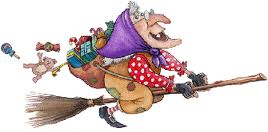 Babbo Natale (Santa Claus) didn’t check everything off your list? Not to worry. You get a second chance tonite.
Kid’s all over Italy are getting ready to hang up their stockings for la Befana to fill this eve of Epiphany, January 6, the day of when the wise men are said to have arrived in Bethlehem.
Just like Babbo Natale, la Befana flies through the air (in place of a sleigh with reindeer, 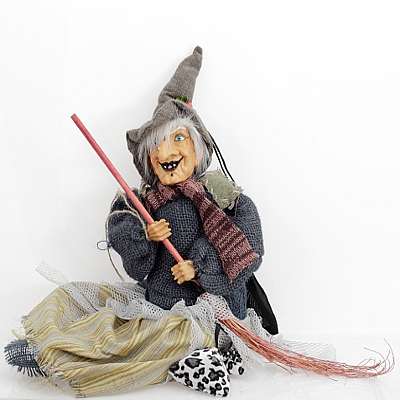 the Befana flies a broomstick – both pretty incredible, really) from house to house where there are bambini, entering by way of il camino (the chimney) and leaving treats for i bambini che sono stati buoni (the kids who have been good) and coal for i bambini cattivi (the naughty children). No mention is made of whether she has a list that she checks twice, but I digress . . .
Where Babbo Natale is rotund, merry, white-bearded and dressed in red and white, la Befana is depicted as a smiling , grandmotherly-looking witch, wearing tattered clothing and covered in soot astride a broomstick.
So what do we know of la Befana’s origins? Well, it’s all pretty much lore; just like what we know of Santa from “Santa Claus is coming to Town”, etc., it’s pretty fantastical… and both seem like stories that pre-date Christian traditions.
 The most common story I encounter is that la Befana lived along the route the Magi took to the Natvity Scene. In this version, they stopped at her house seeking food and shelter, but she wasn’t feeling sociable and sent them away. Later, la Befana has a change of heart and sets out to find the Magi, and to accompany them to find the Christ Child. But by now, she’s too late to catch up, and she never finds the child. So, as the story goes, to this day, at this time of year, she still travels the world, leaving gifts for every child, lest they be il Gesu` Bambino (the Baby Jesus).
What does the Befana bring to good children? That depends on the traditions (and budget) of the household where they live. Most just get little treats, candies and gizmos, similar to what St. Nick (from whom Santa Claus derives) puts in stockings of kids whose families observe St. Nicholas Day (Dec. 6), but some lucky kids get iPods and other such fancy loot!
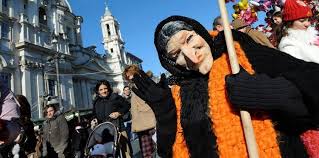 Most cities hold special events and parties dedicated to celebrating la festa dell’Epifania/la Befana (Epiphany holiday). People play bingo and cards, and gather outdoors in the piazze (squares) for festivities, including music, processions, live nativity scenes, open-air markets, live appearances by la Befana, and more. You’ll find links to a few of these happenings below.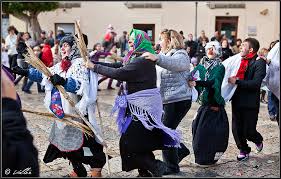
And while it’s mainly a celebration for the kiddies, you’ll find adults getting in on the action, too, dressing up and parading around as la Befana in carne e ossa (in the flesh). The picture here looks like a sort of Befana bunny hop!
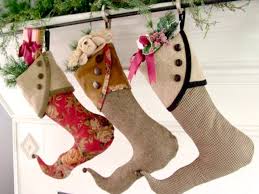
Feeling festive? Perhaps you want to get into the act, too. This could be a great time to adopt a fun new tradition, with kids and family or friends and housemates. All you need is una calza (a sock or stocking) – any type, even a long sock will do – and some little treats!
Buona Befana!
Have you ever heard of or celebrated la Befana? Comments welcome!
Epiphany/Befana celebrations in Italy: Roma-Milano-Napoli | Ostia | Baby Befana Party
Note: This post is in Italian interspersed with the approximate English translation.
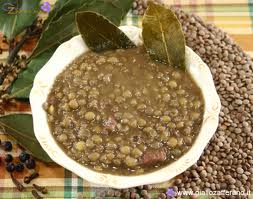
 Secondo l’usanza italiana, se ti vuoi assicurare di un nuovo anno fortunato, a Capodanno devi mangiare le lenticchie. Piatte e tonde, assomigliano le monete, e per il fatto che aumentano in misura durante la cottura, simboleggiano soldi e crescita finanziaria. Di solito in Italia le lenticchie si preparano in forma di una gustosa zuppa che viene mangiata nel periodo di Capodanno.
According to Italian custom, if you want to be sure to have good luck in the new year, you must eat lentils on New Year’s Eve/Day. Flat and round, they resemble coins, and due to the fact that they expand in size during cooking, they symbolize money and financial growth. In Italy, lentils are usually prepared in the form of a tasty soup that is eaten during the New Year period.
Ecco la mia ricetta – e` deliziosa e abbastanza facile. Buon appetito e prospero anno !
Here’s my recipe – it’s delicious and pretty easy. Good eating and prosperous new year!
Zuppa di lenticchie | Lentil Soup
Persone: 4 | Preparazione: 30 minuti | Cottura: circa 2 ore | Difficolta`: medio
Serves: 4 | Preparation: 30 minutes | Cooking time: about 2 hours | Difficulty: medium
Ingredienti | Ingredients [Italian | English]
300 gr lenticchie verdi secche | 10-11 oz dry green lentils
1-2 cucchiai olio d’oliva | 1-2 tblsp olive oil
1-2 cucchiai di burro | 1-2 tbsp butter
peperoncino q.b. /quanto basta | red chili pepper, to taste
1 cipolla tritata | 1 chopped onion
1 costola di sedano tritata | 1 stalk of celery, chopped
2 gambi di porro tritati | 2 bulbs/stems chopped leeks
1 carota tritata | 1 chopped carrot
1 bicchiere di vino bianco secco | 1 c./8oz. dry white wine
1 pomodoro piccolo tritato | 1 small chopped tomato
1 foglia di alloro | 1 bay leaf
8-10 bicchieri/2-2 ½ litri d’acqua | 8-10 c./2-2 ½ Qt. water
Dadi di brodo vegetale q.b./quanto basta (circa un dado per litro d’acqua) | Broth cubes, as needed (approx. 1 cube per quart of water)
Sale e pepe, q.b. / salt and pepper, to taste
Qualche rametto di timo fresco | A few sprigs of fresh thyme
Facoltativo: 300 gr cotechino o altra salsiccia, | Optional: 10-11 oz. “cotechino”, a traditional Italian pork sausage, or other sausage
 Preparazione | Preparation
Sciacquate le lenticchie e mettetele in ammolo in acqua fredda per circa 2-3 ore.
Rinse and soak lentils in cold water for approx. 2-3 hours.
Riscaldate l’acqua con i dadi di brodo e tenetela coperta a fuoco lento finche occorre.
Heat the water with broth cubes and keep covered at a simmer until needed.
Trascorso il tempo di ammollo, potete iniziare a preparare la zuppa di lenticchie. In una pentola grande rosolate cipolla, porro, sedano e carote tritati nel burro e l’olio d’oliva.
Upon completion of soaking time, in a large pan sauté the chopped onion, leeks, carrot and celery in the butter and olive oil, until onion is transparent.
Aggiungete le lenticchie, ben scolate dall’acqua di ammollo,e la foglia di alloro, girandole 1-2 minuti mentre assorbono il burro, l’olio ed i gusti della verdura.
Add lentils, having drained the soaking water, and the bay leaf, stirring 1-2 minutes as they absorb the butter, oil and flavors of the vegetables.
Aggiungete e fate sfumare il vino bianco, girando il tutto a fuoco basso.
Add white wine and stir the mix while sautéing so wine absorbs into lentils as it evaporates.
Aggiungete il pomodoro e girate a fuoco lento.
Add tomato and stir while sautéing.
Aggiungete sale e pepe quanto basta.
Add salt and pepper to taste.
Aggiungete circa la meta` del brodo e coprire la pentola. Controllate, girate ed assaggiate di tanto in tanto, aggiundendo del brodo in piu` quando occorre ed evitando che le lenticchie si attaccano. Attenzione che le lenticchie ultimate siano al dente e non stracotte.
Add about half the broth and cover the pan. Check, stir and taste every so often, adding more broth as needed to avoid lentils cooking to the bottom of pan. Take care that the finished lentils are “al dente” and not overcooked (when ready, lentils should be soft but not mushy).
Aggiungete del sale quanto basta.
Add salt as needed/to taste.
In una padella a parte, fate rosolare le salsicce. Abbiate cura a non stracuocerle. Alla fine della cottura la pelle sara` diventata biancastra. Dovrebbero essere tenere e non dure.
In a separate pan, steam the sausage(s). Be careful not to overcook. When finished, the casings will have turned white. They should be tender, not tough.
Quando le salsicce saranno ultimate, toglietele dalla fiamma e togliere la pelle.
When sausages are cooked, remove from heat and remove casings.
 Quando la zuppa di lenticchie sara` ultimate, toglietela dalla fiamma, togliete la foglia di alloro, aggiungete del timo fresco e mescolate. Affettate le salsicce, mettete le fette in cima alle porzioni di zuppa ed aggiungete un rametto di timo fresco.
When lentils have finished cooking, remove from heat, remove bay leaf, add the leaves of several fresh sprigs of thyme and mix. Slice the sausages, put slices over the top of the portions of lentil stew, add a sprig of thyme and serve. Buon appetito!
Avete mai mangiato la zuppa di lenticchie? Mangiate qualche cibo speciale a Capodanno? | Have you ever eaten lentil soup? Do you eat any special foods at New Year’s?
 Panama… Una Escapada de la Ciudad (Span.) | An Escape from the City…
After so much hustle and bustle in the city, exciting as it is, it was time to get out of town for a spell, para un cambio de paisaje (literally: for a change of landscape, English expression: for a change of scenery, Italian: per cambiare aria), so we hopped in el carro (It. la macchina) the car and headed about an hour and a half southwest of Panama City to explore the Valle de Anton.
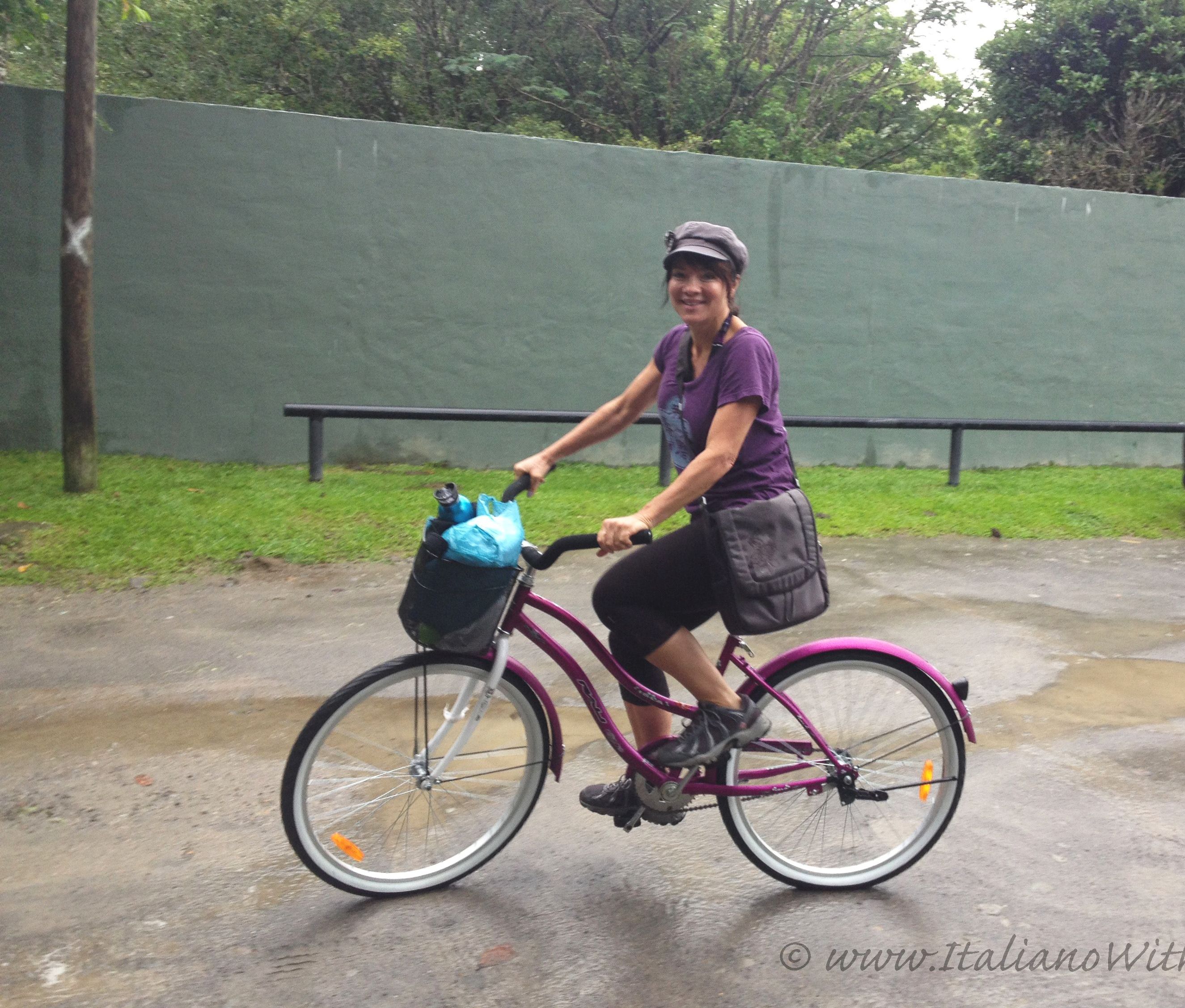 Lush, slightly cooler, quiet and slow-paced, it was just what we needed.What struck me most about this place was the greenery and the water–so much in evidence everywhere – animals roaming freely, and more pedestrians and bicycles on the roads than cars. Hemos alquilado bicis para explorar el pueblo! (We rented bikes to explore the town!) Let’s take a spin through the Valle de Anton…
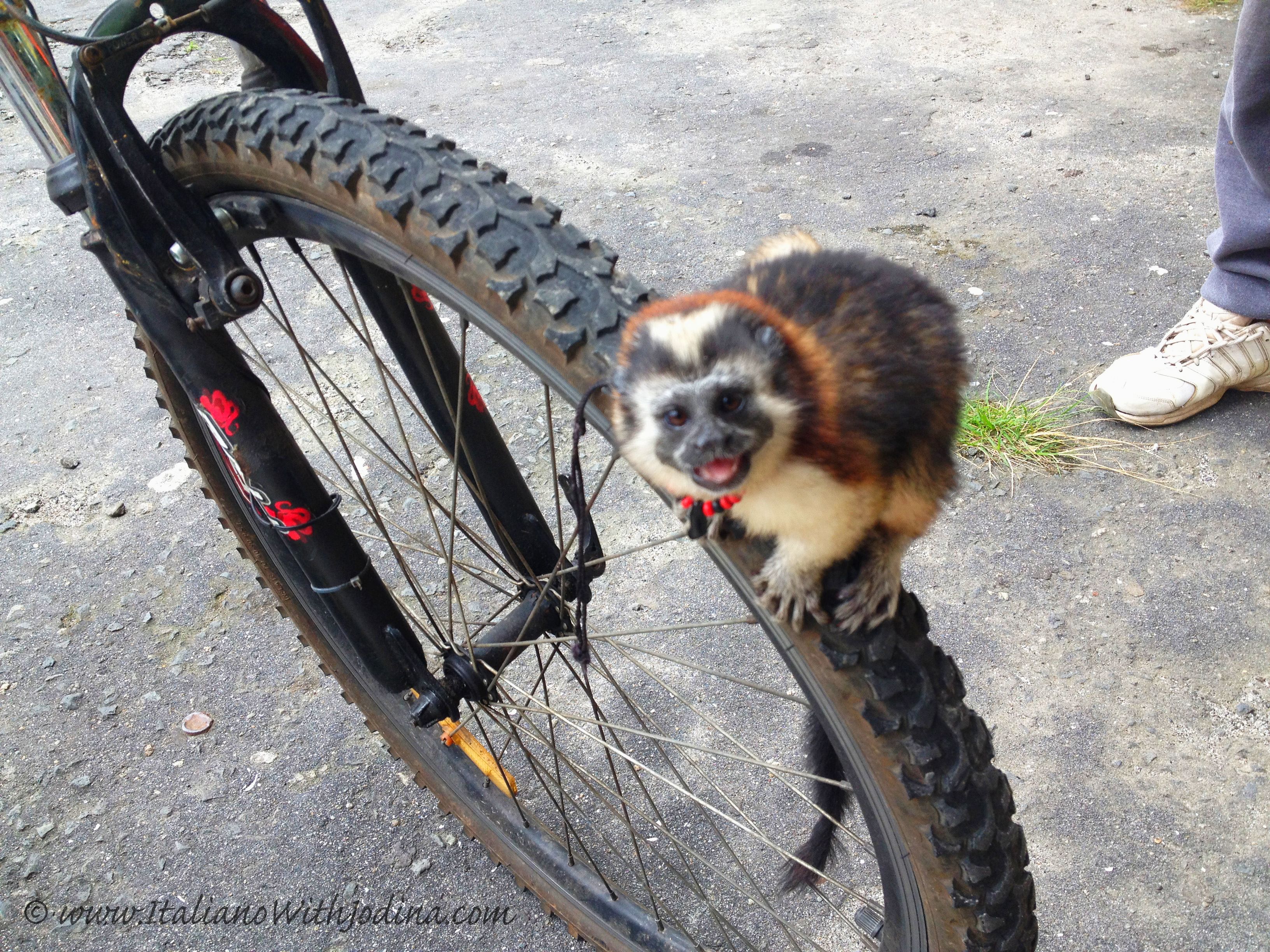
Tiny tamarin monkeys sound like birds. This little guy, posing on the bike tire of his human, a local guide, is about a year old.
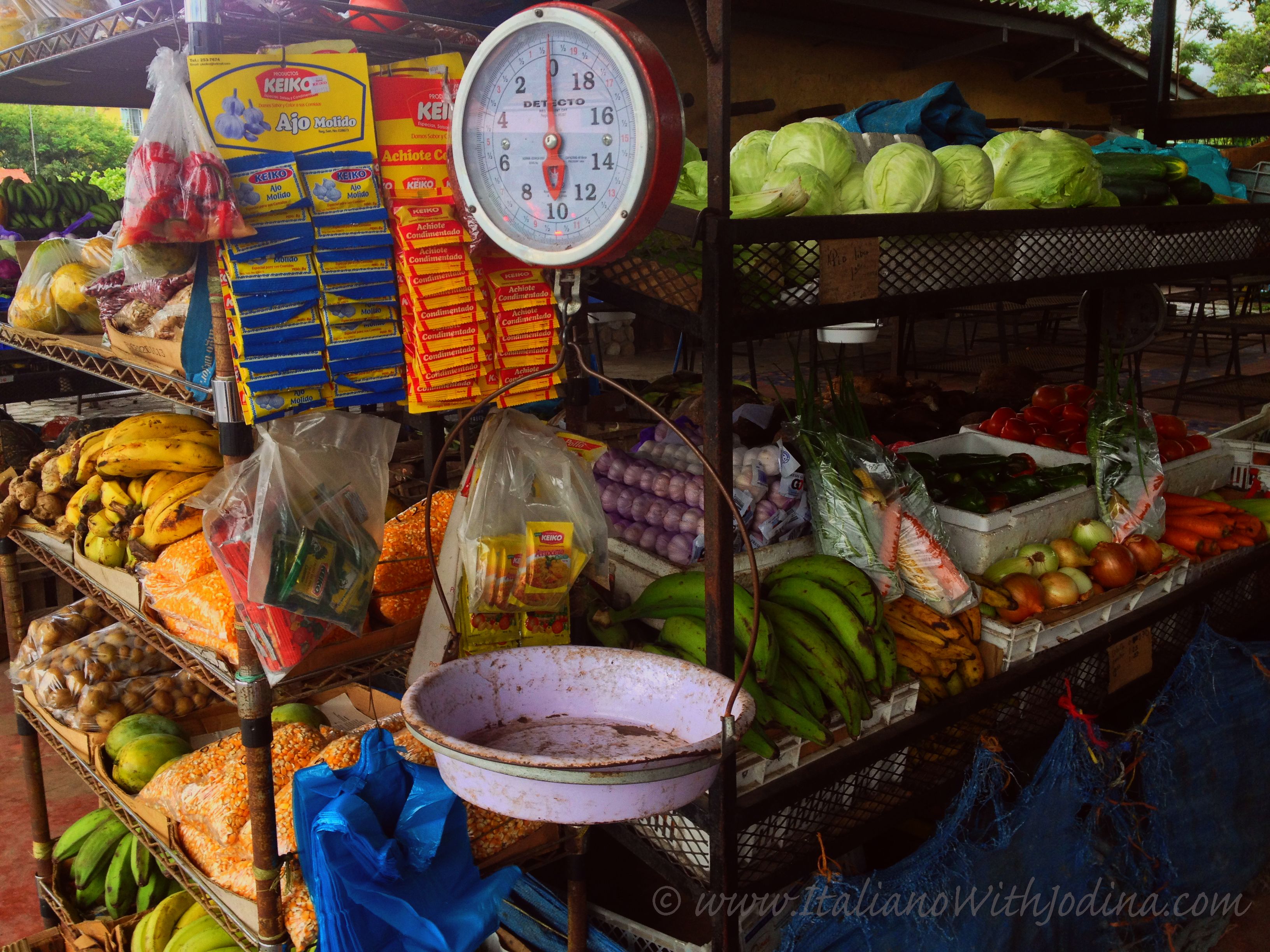
Una balanza al Mercado Publico. En vista tambien hay el platano ubicuo, zanahorias, ajo, cebollas, y repollo. / A scale at the Public Market. Also in view: the ubiquitous plantain, carrots, garlic, onions and cabbage.
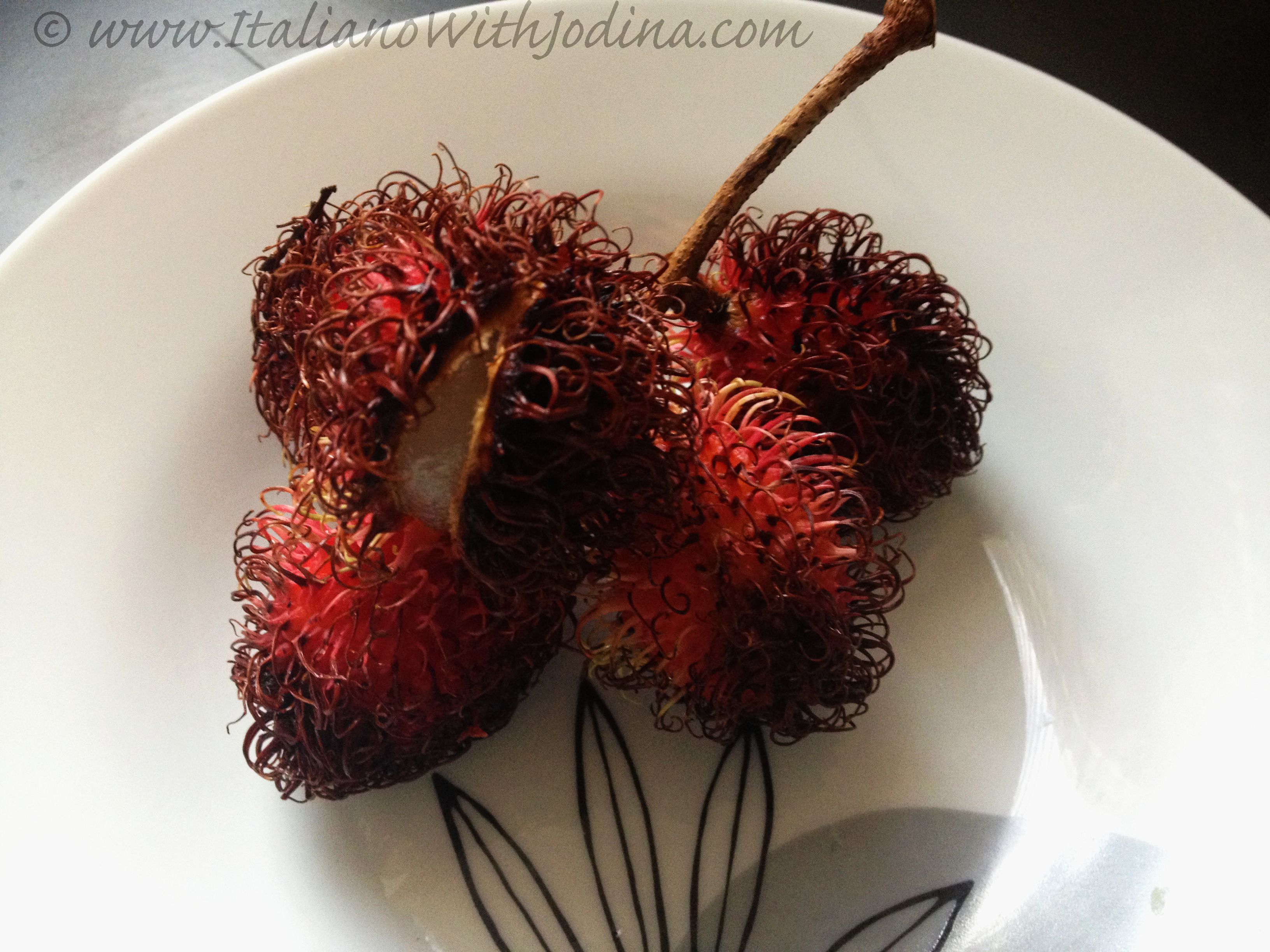
Mamones chinos, similar to lychee fruit. The market vendor sold me “cuatro por cuara”, four for a quarter, (cuara is Panamaniam slang for 25 cents, from the English word quarter).
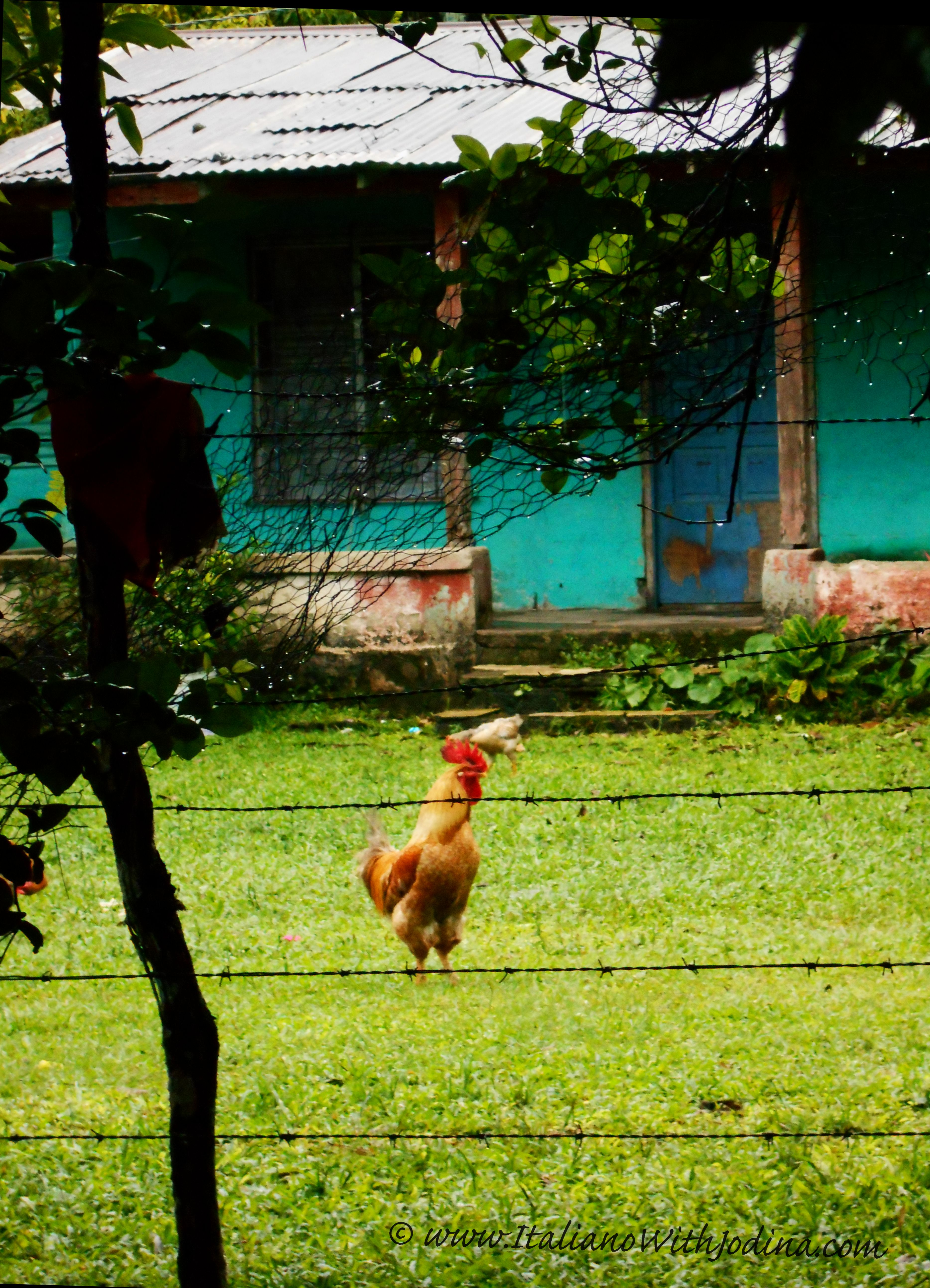
Un gallo (a rooster) — they seem to be everywhere! — in front yards and along the roads.
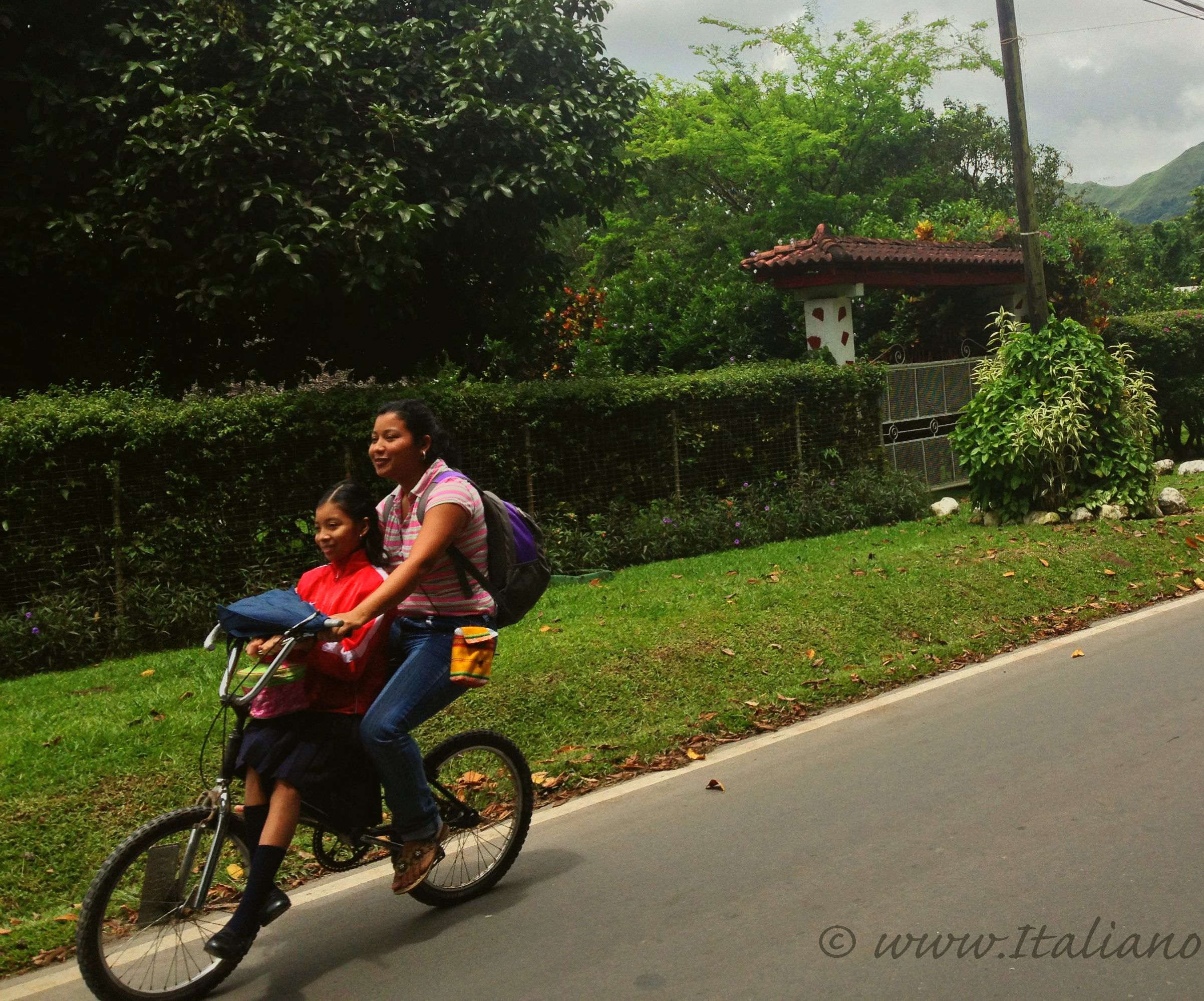
Una mamà lleva s su hija a la escuela (a mom takes her daughter to school). Look closely, both are smiling. People here seem peaceful and content.
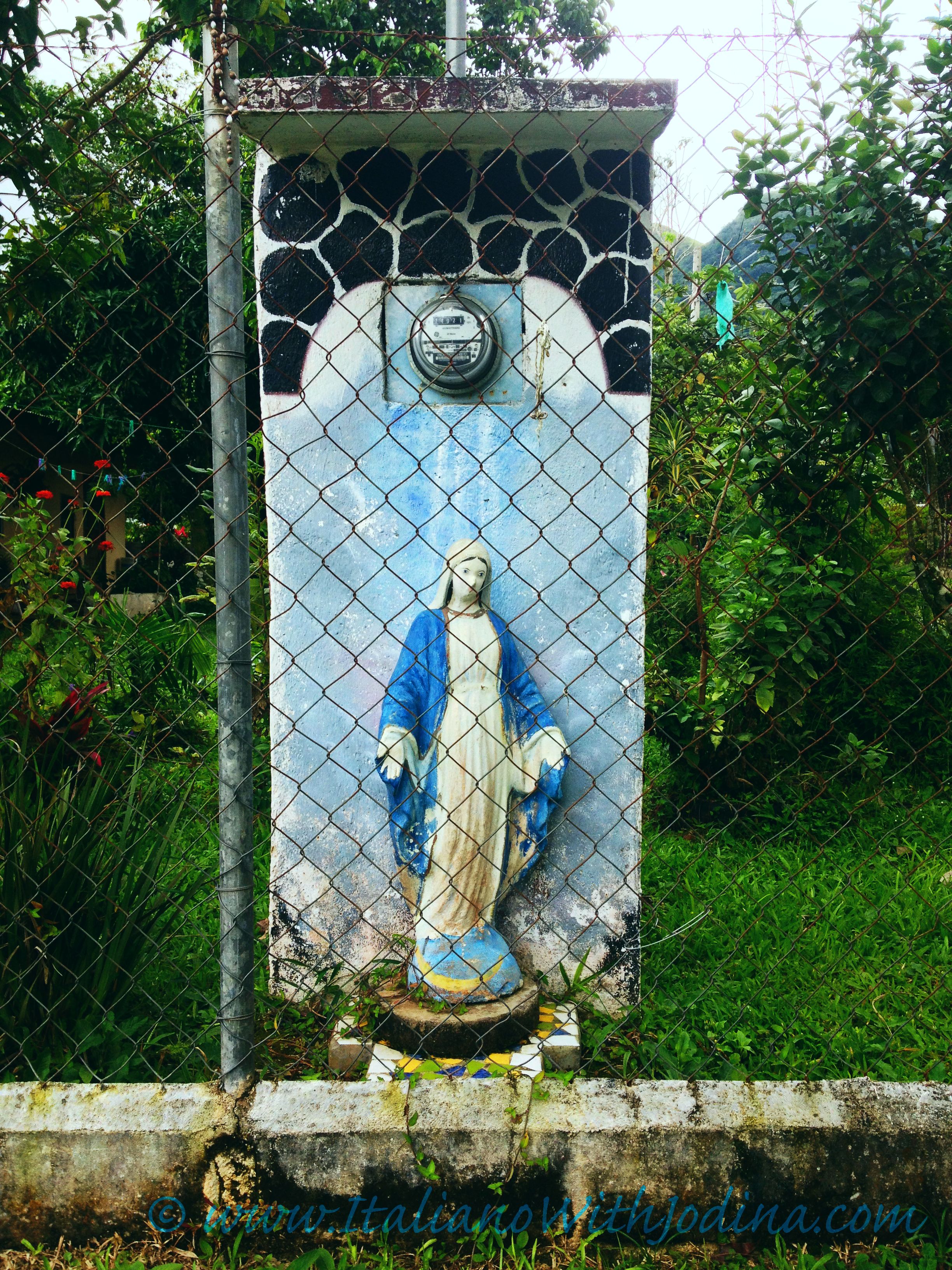
Sacred meets profane meets utility: a Madonna graces an electricity meter.
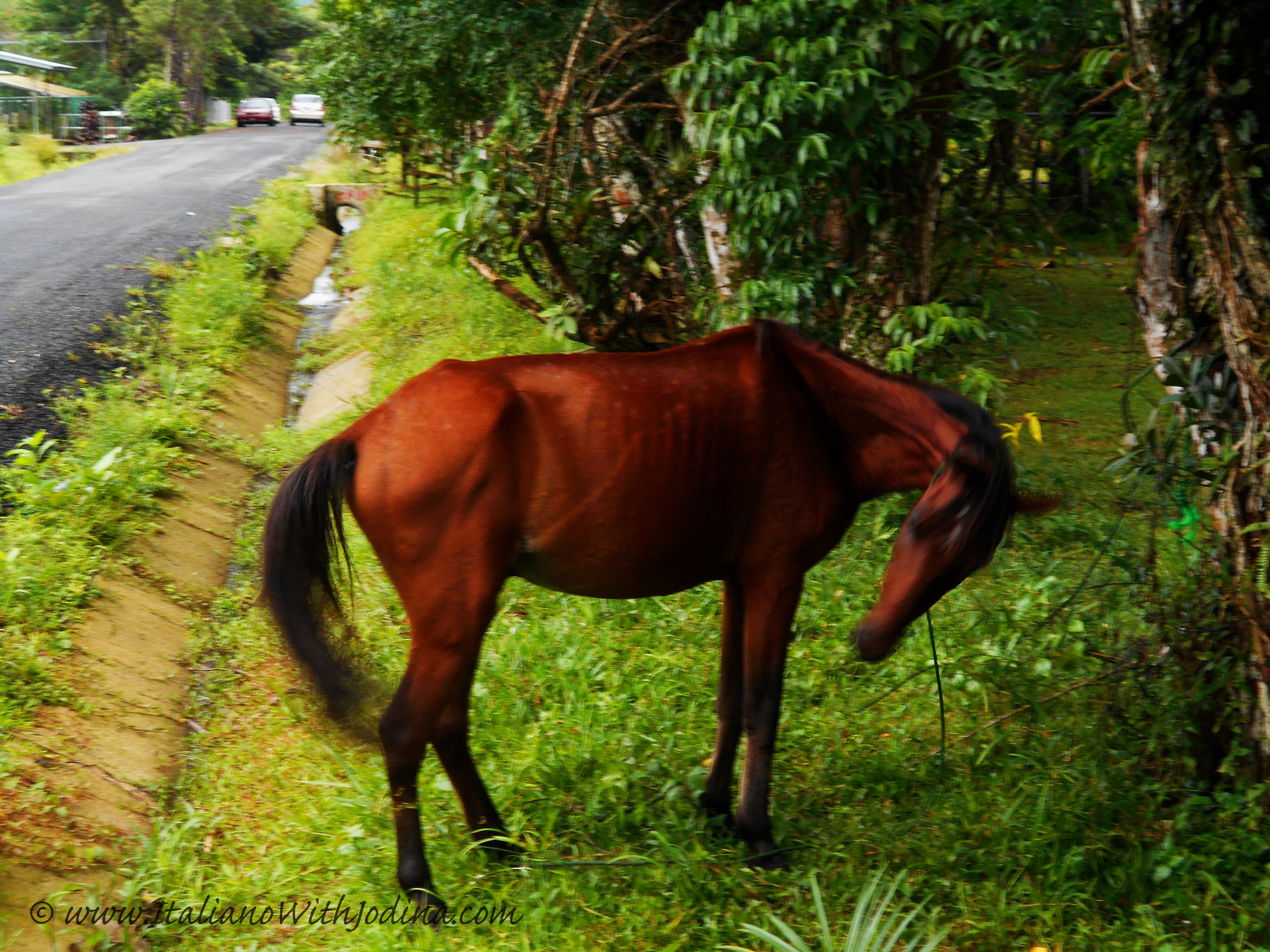
Un caballo (It. Un cavallo) A horse grazes by the roadside.
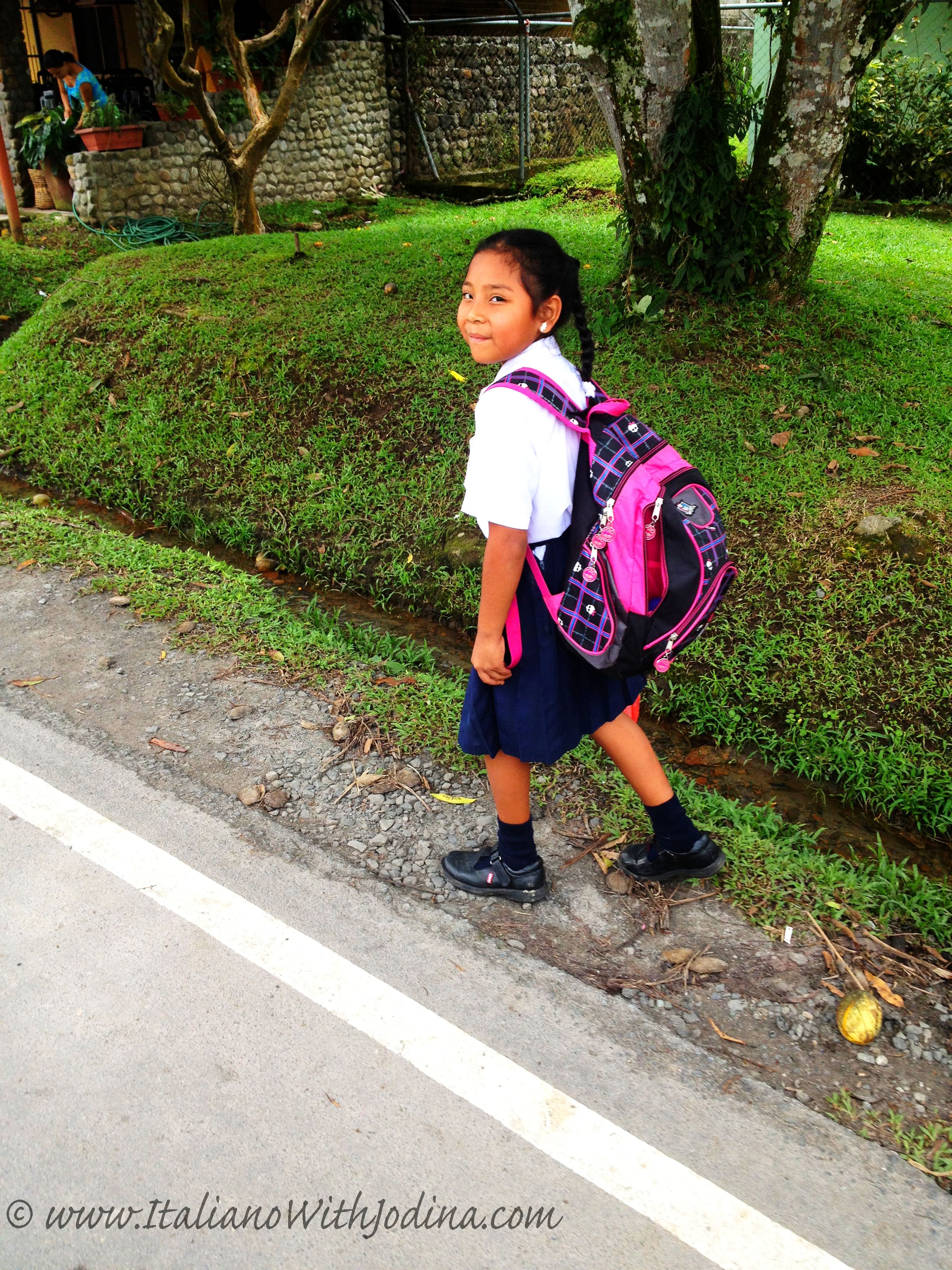
What a cutie, she definitely looks like she’s in on the joke!
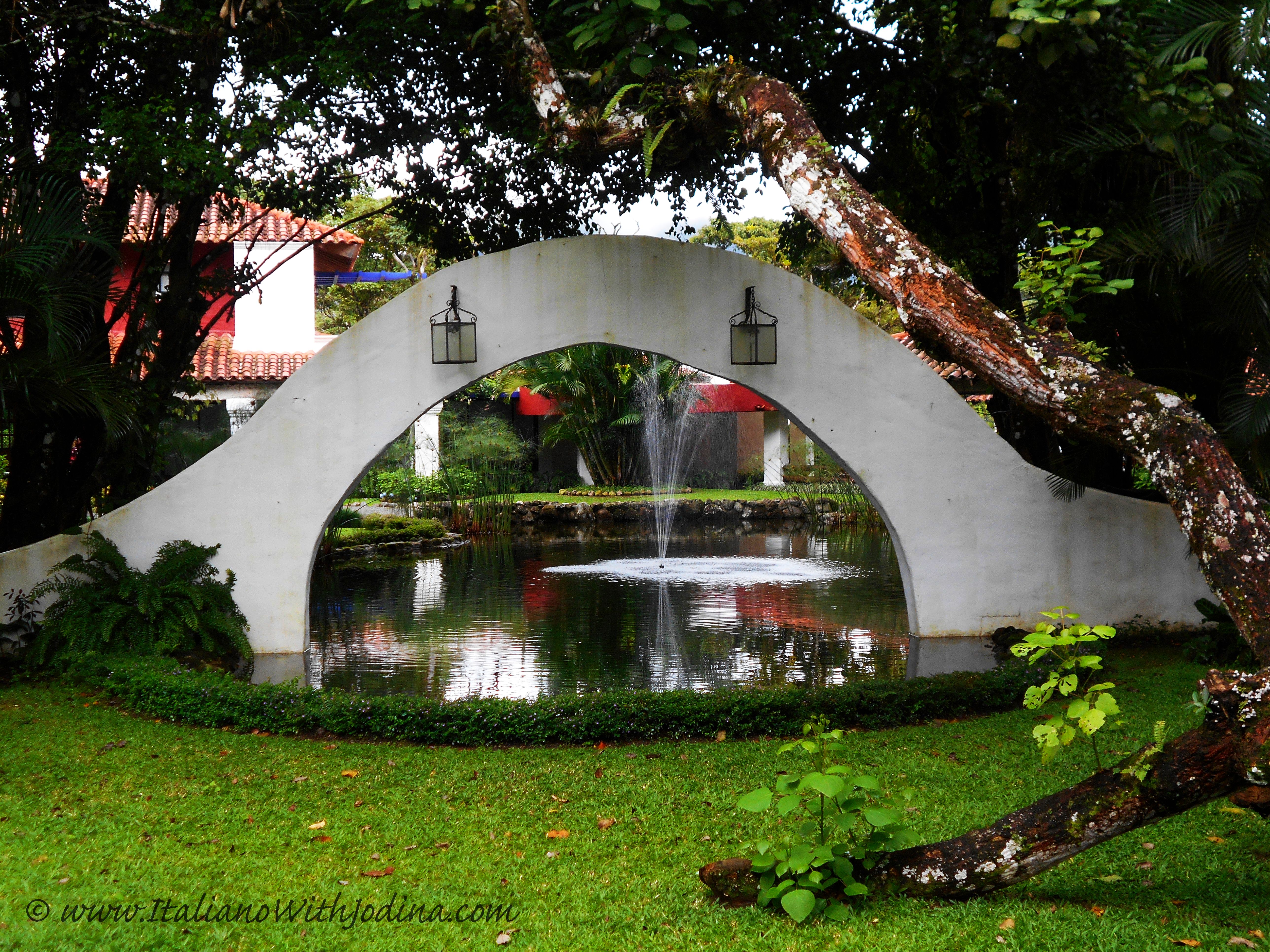
Front yard of a villa on Calle Los Millionarios (Millionaires Road), where Noriega and his gang used to have country homes. The gangsters are gone, but las casas bellas quedan (the beautiful houses remain).
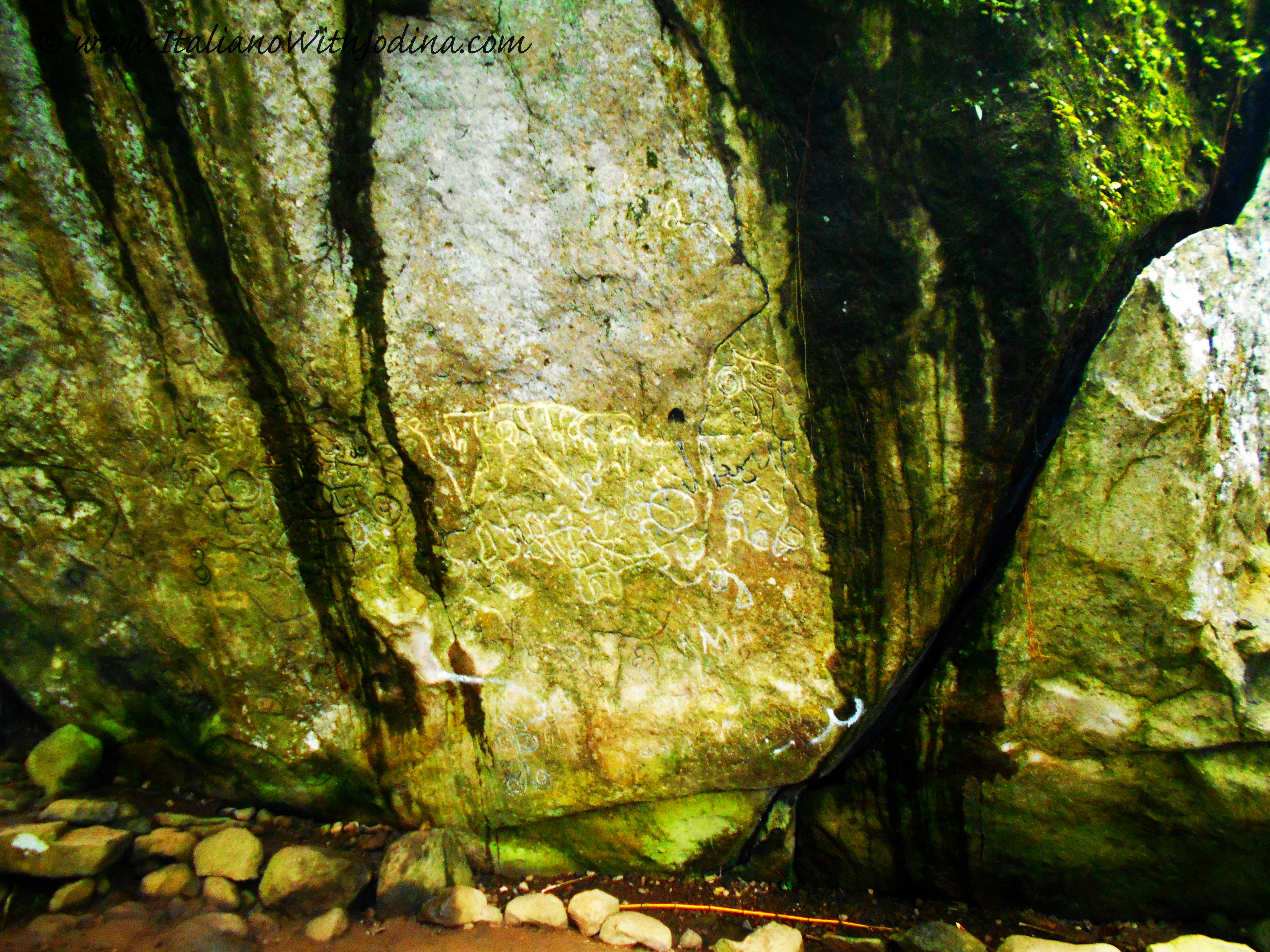
The main event: La Piedra Pintada (the Painted Rock), a remnant of El Valle’s pre-Columbian culture, is a 15-ft boulder featuring a collection of ancient petroglyphs.
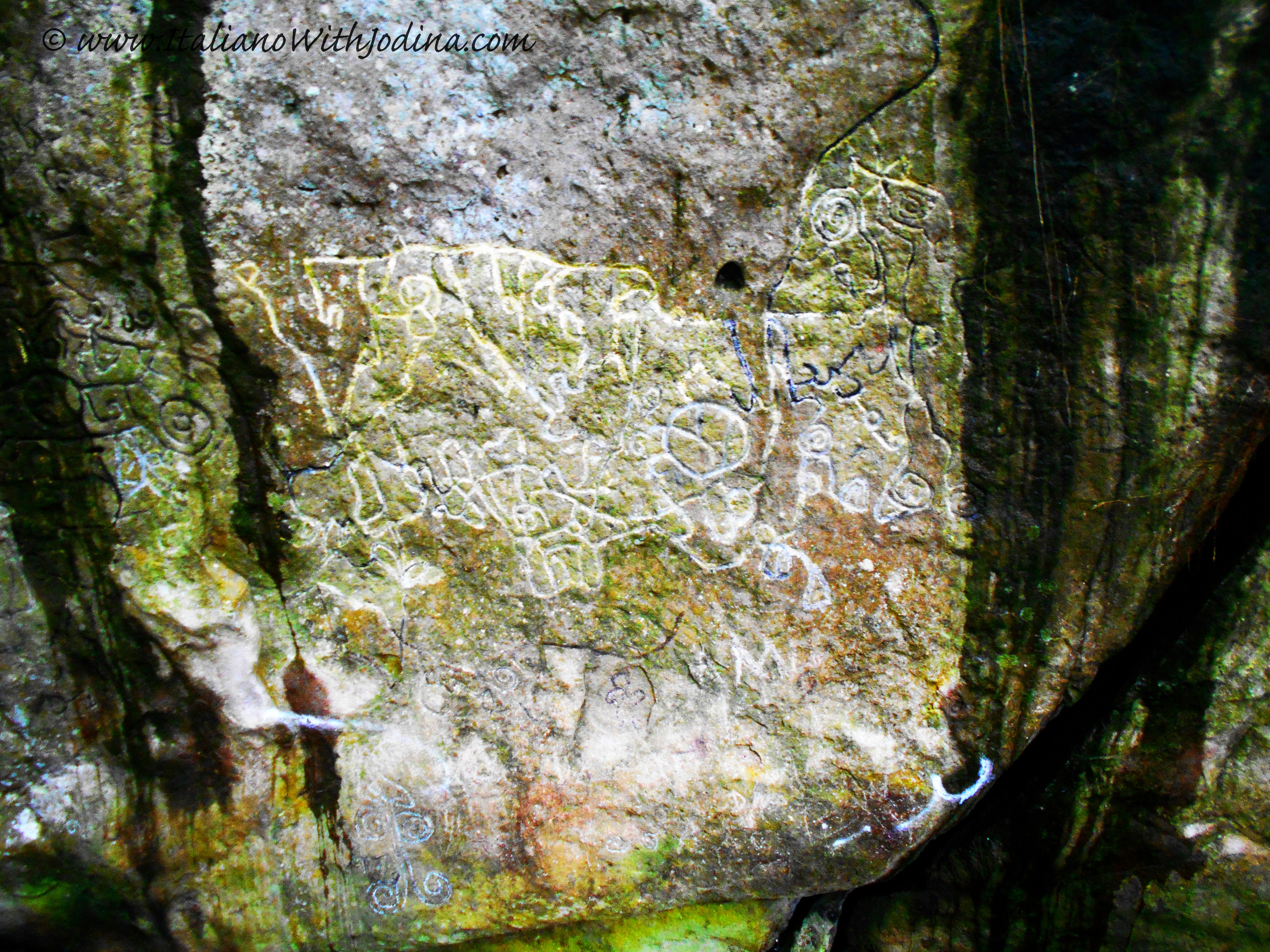
Closeup of la PIedra Pintada, the Painted Rock. It makes me thimk of an ox (It. un bue, Sp. Un buey).
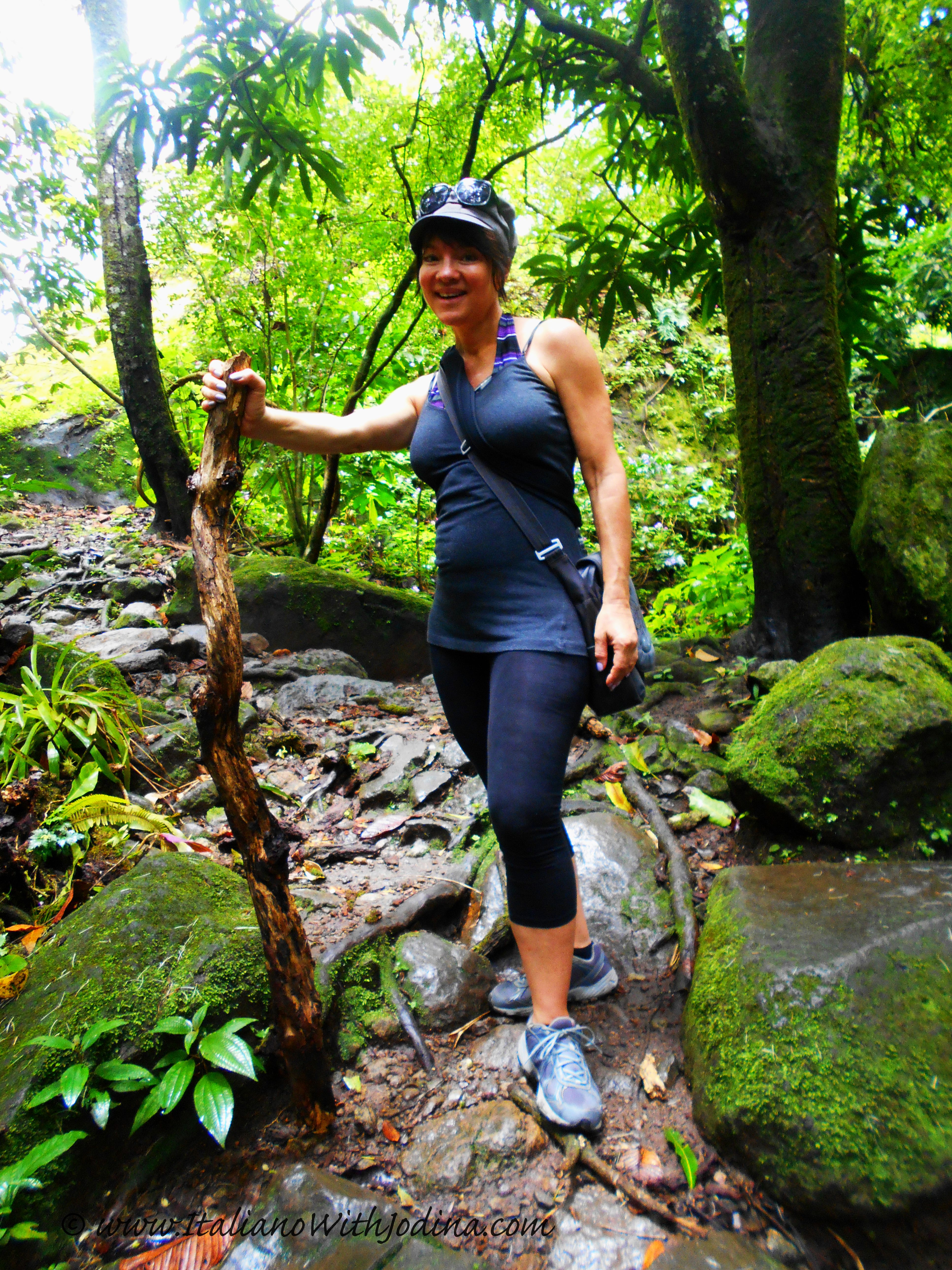
On the sendero (path) de la Piedra Pintada. Climbing that rock fearlessly!
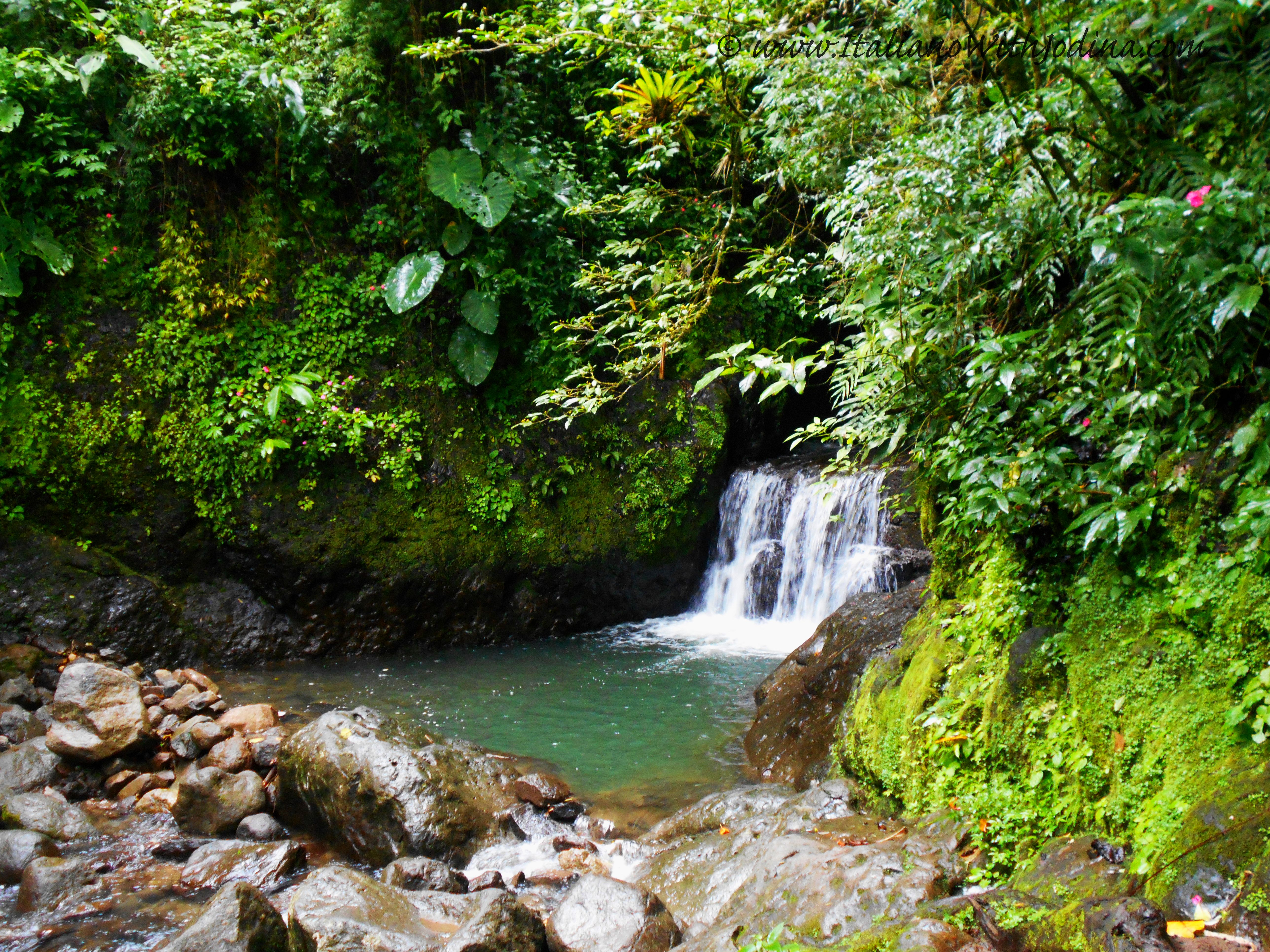
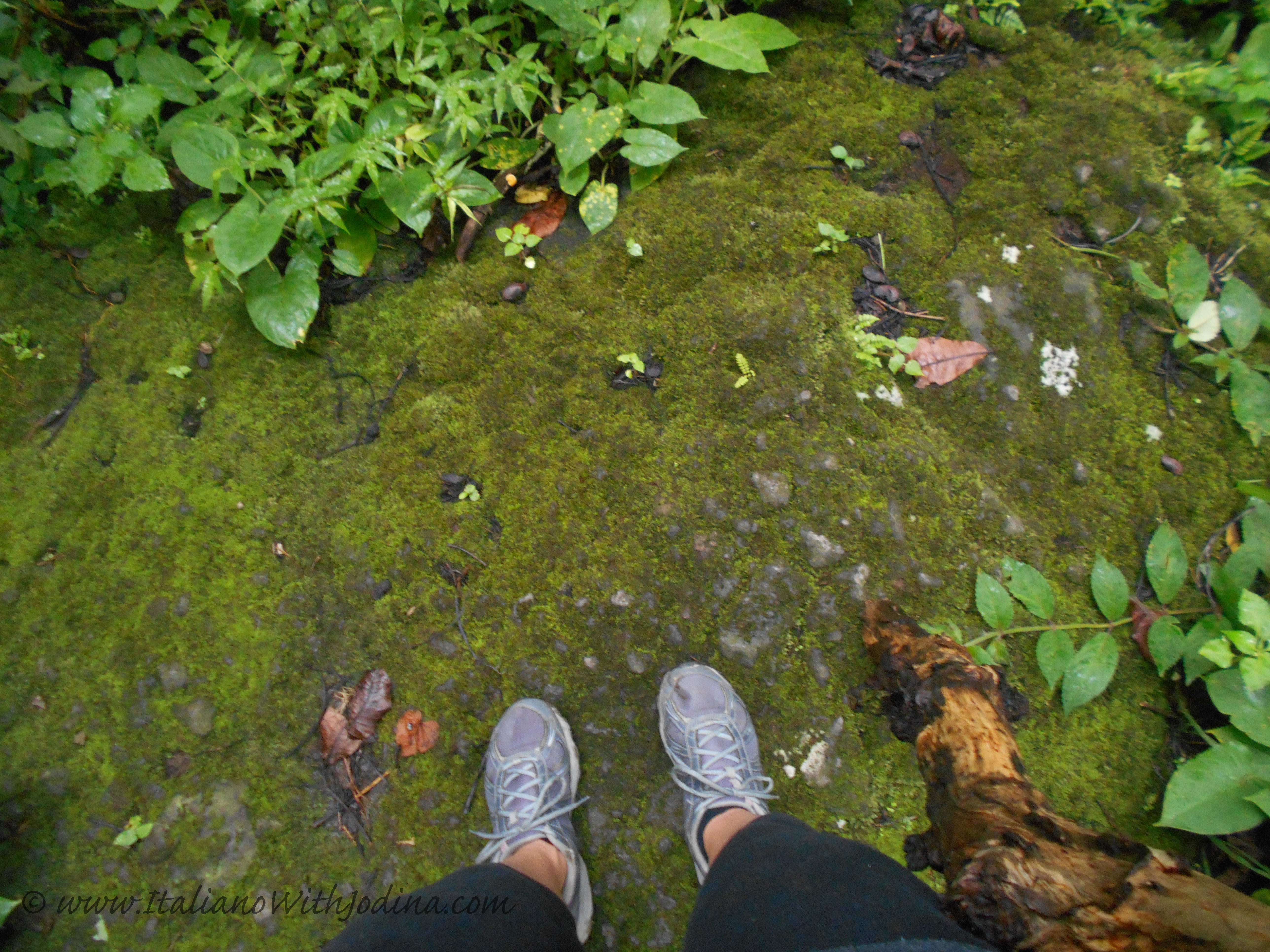
Una cascada tropical (It. una cascata tropicale) a tropical waterfall along the path.
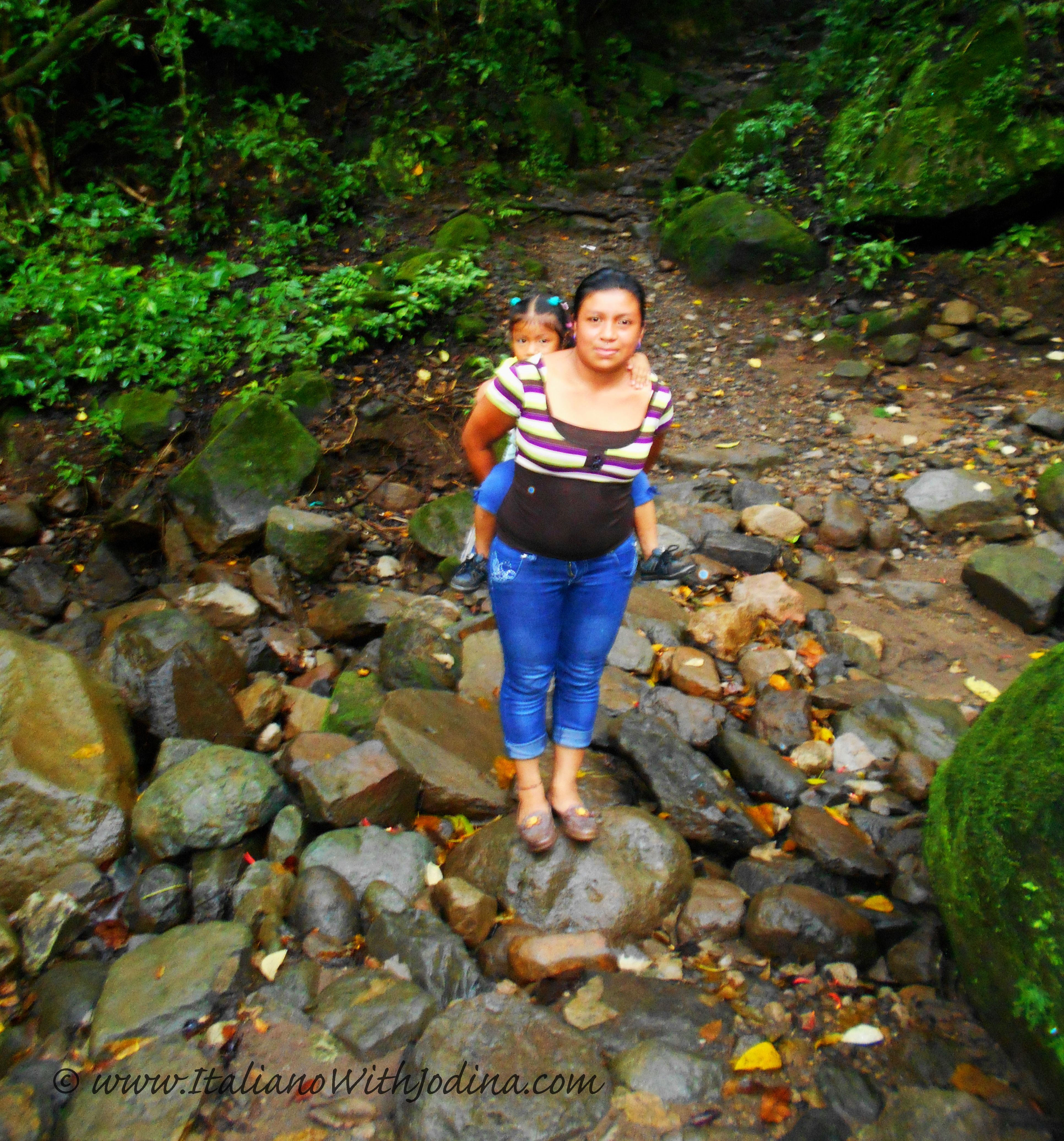
All along the upward path there are small trails leading to people’s homes. This mom travels on foot with her small daughter… 40 minutes round trip — 60 with groceries, she tells us.
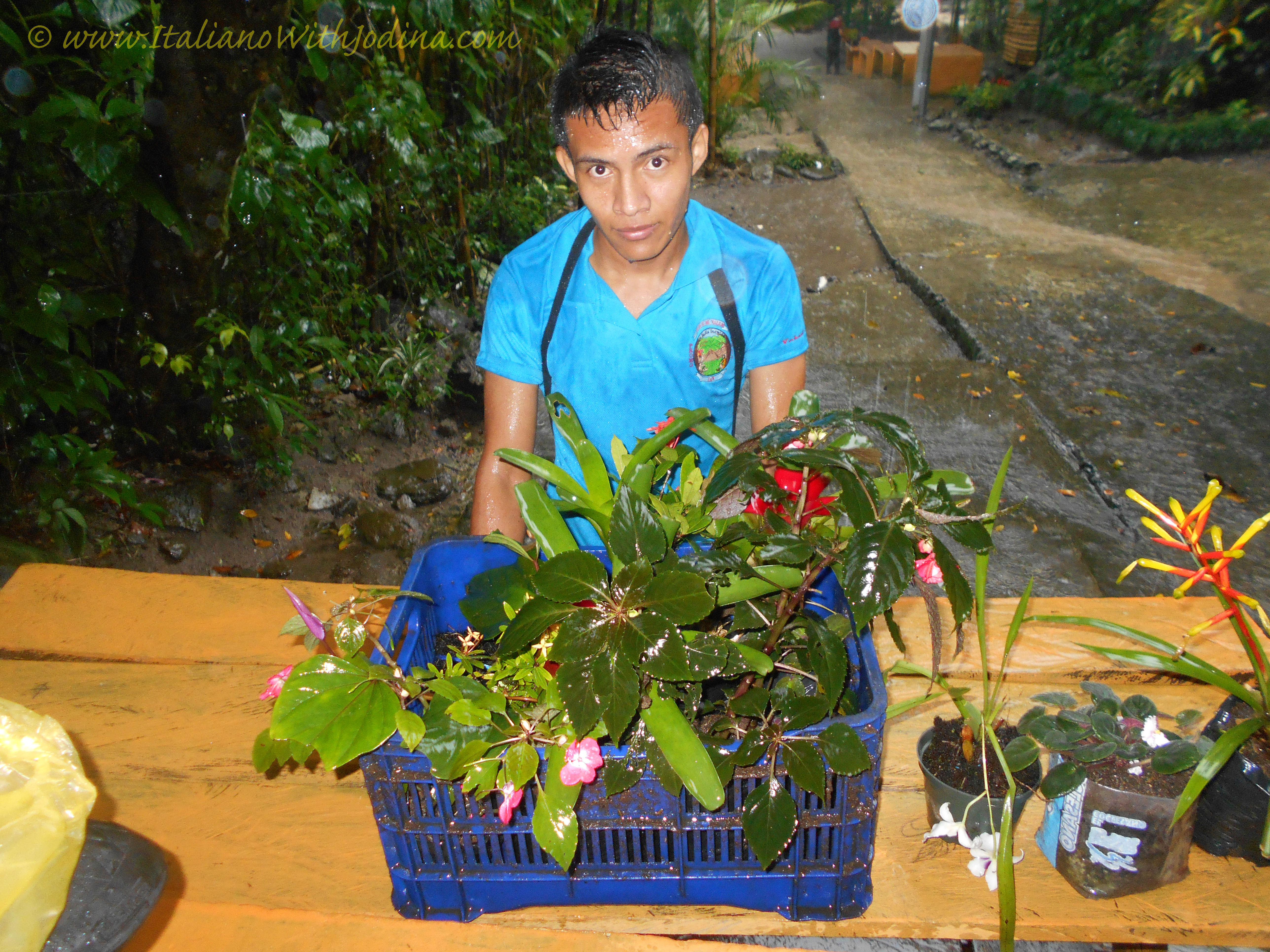
A park worker carries plantas jovenes (young plants) out of the pelting rain to shelter.
While hiking on the path, we got stuck in a sudden heavy downpour and found ourselves huddling under the leafiest tree we could find, with just one small umbrella and one thin rain poncho between two people.
After about 10 minutes and getting pretty soggy, it
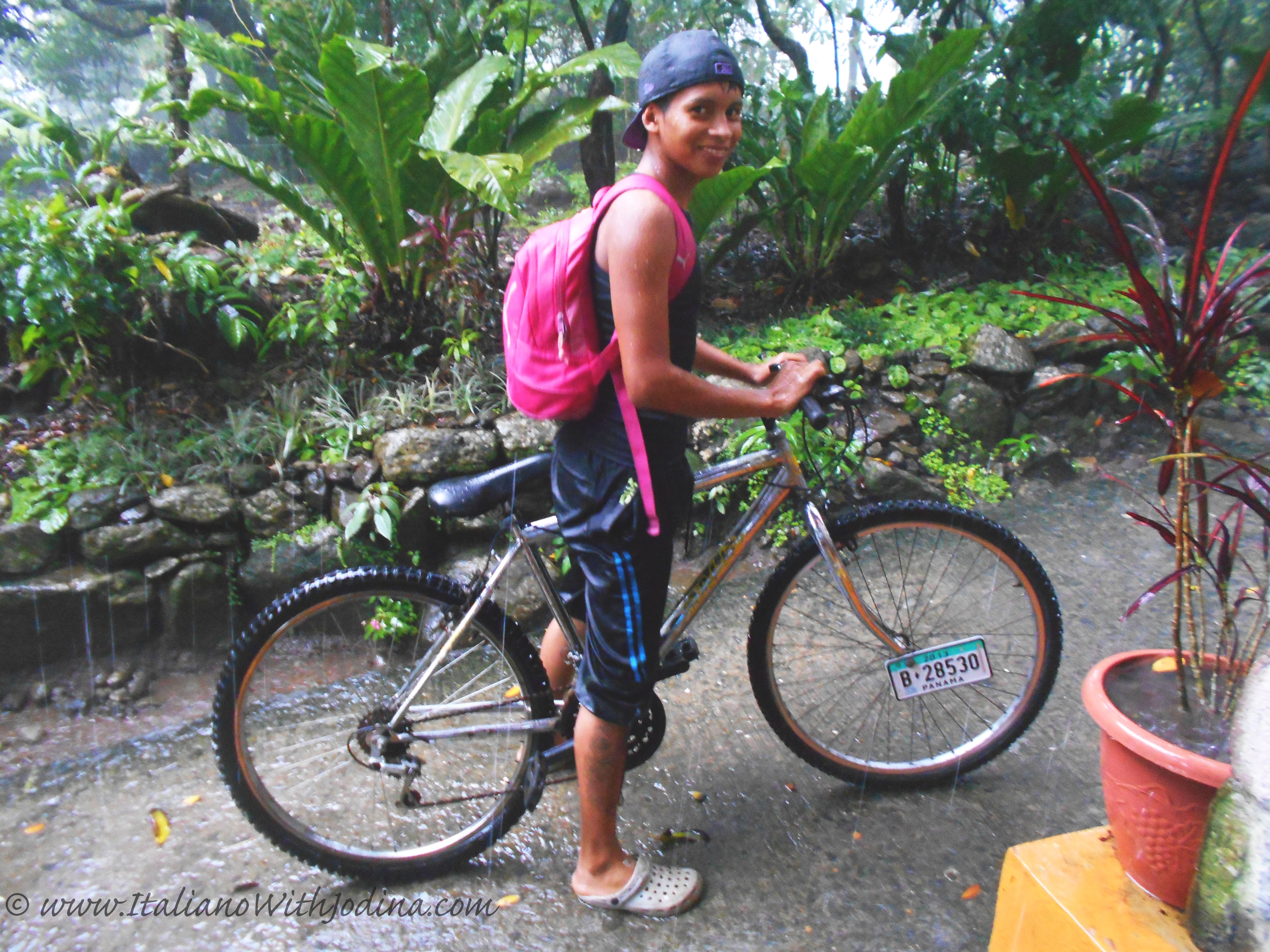
It takes more than a lil’ ol rainstorm to stop folks here!
looked like it would be more than just a flash storm, so we screwed up our courage and carefully descended the slippery path, avoiding gullies of water gushing around us. The rainstorm lasted the better part of an hour, giving us time to take in some interesting scenes along the way…
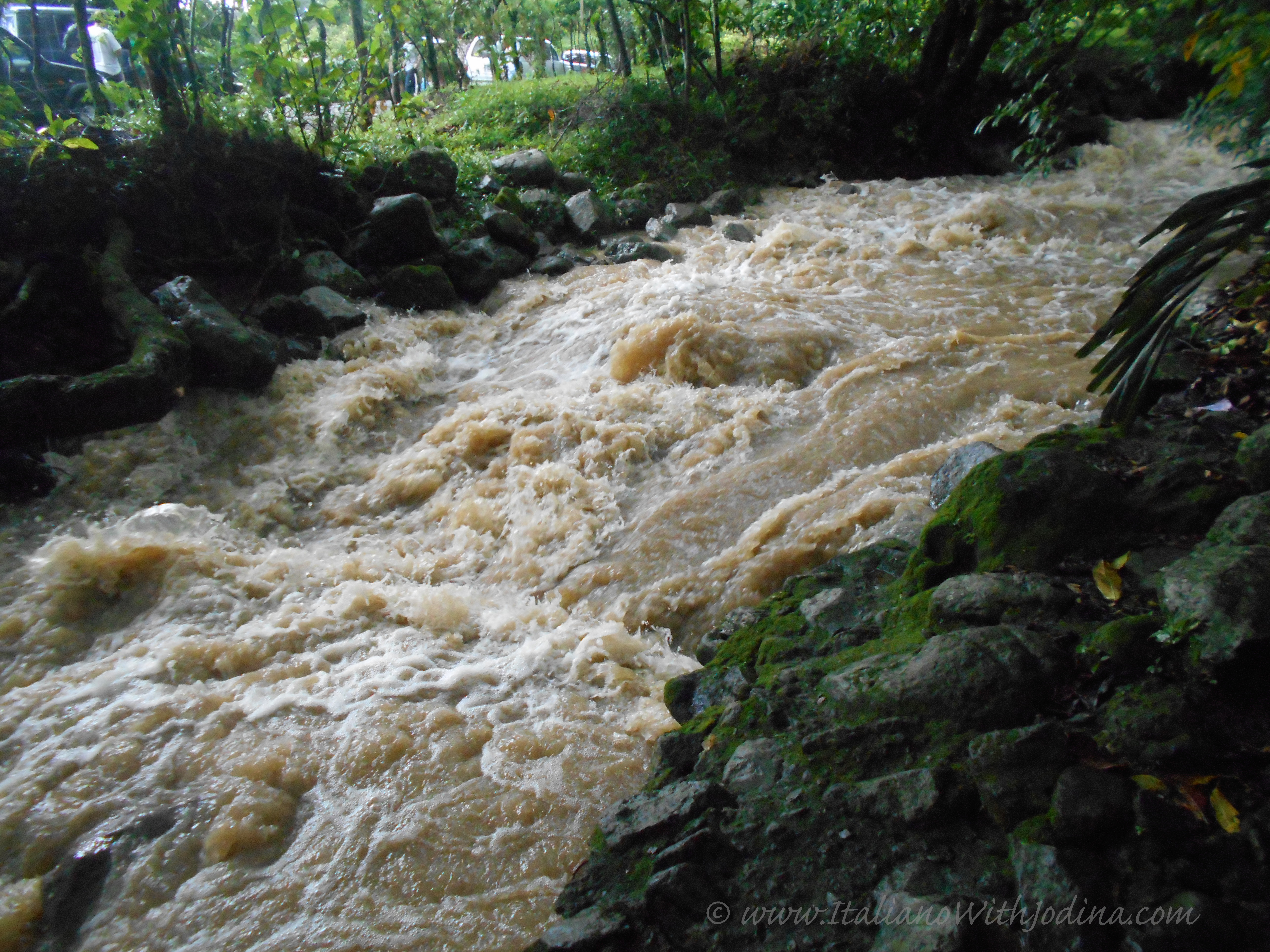
A very churned up Rio Guayabo after an hour-long tropical downpour.
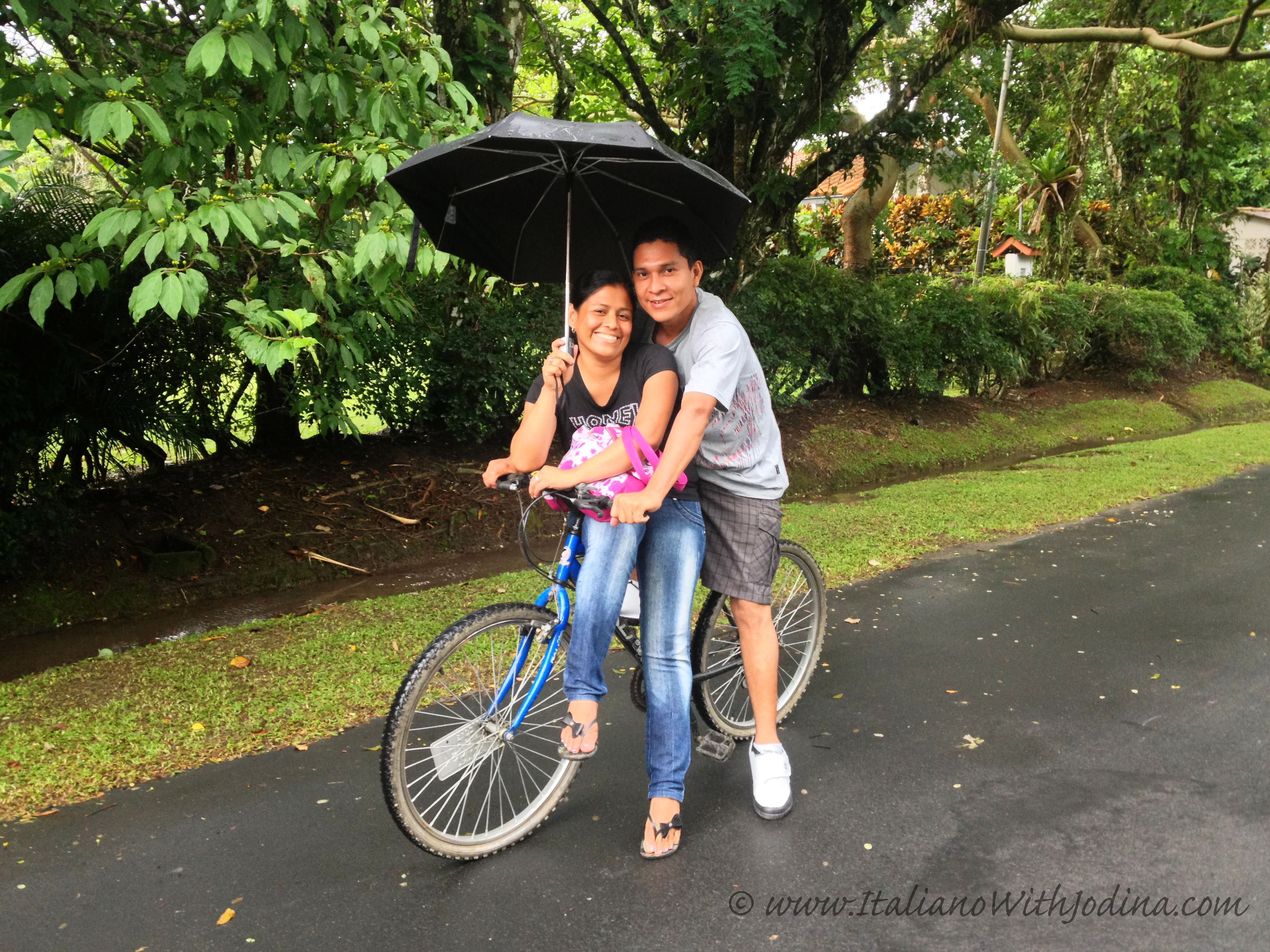
Bikes everywhere! Often with two people aboard. Una pareja feliz (a happy couple) poses in the rain.
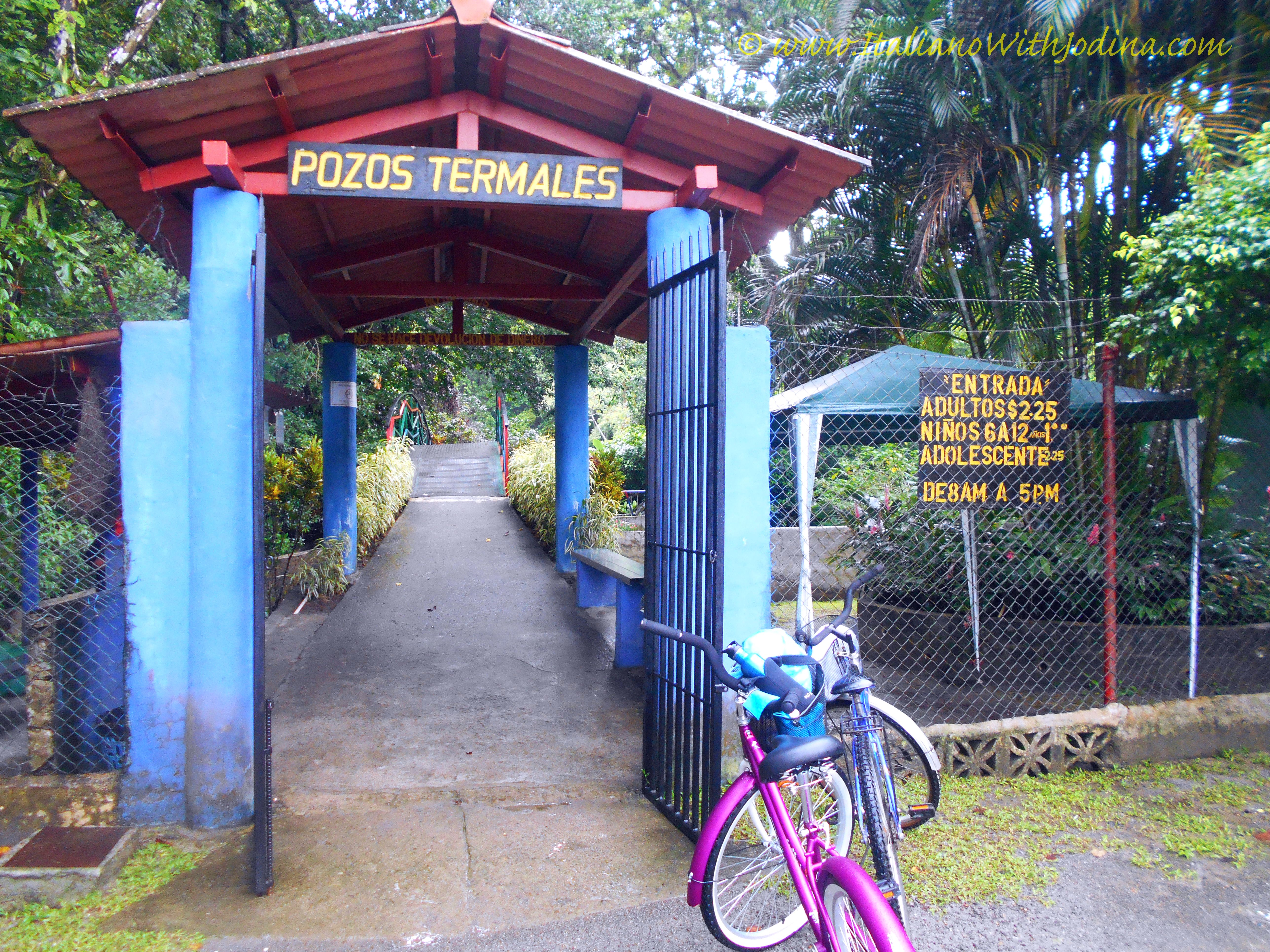
Next, we rode our bicicletas (bicycles) to los Pozos Termales (the hot springs).
$2.25 adult entrance fee — deal of the century!
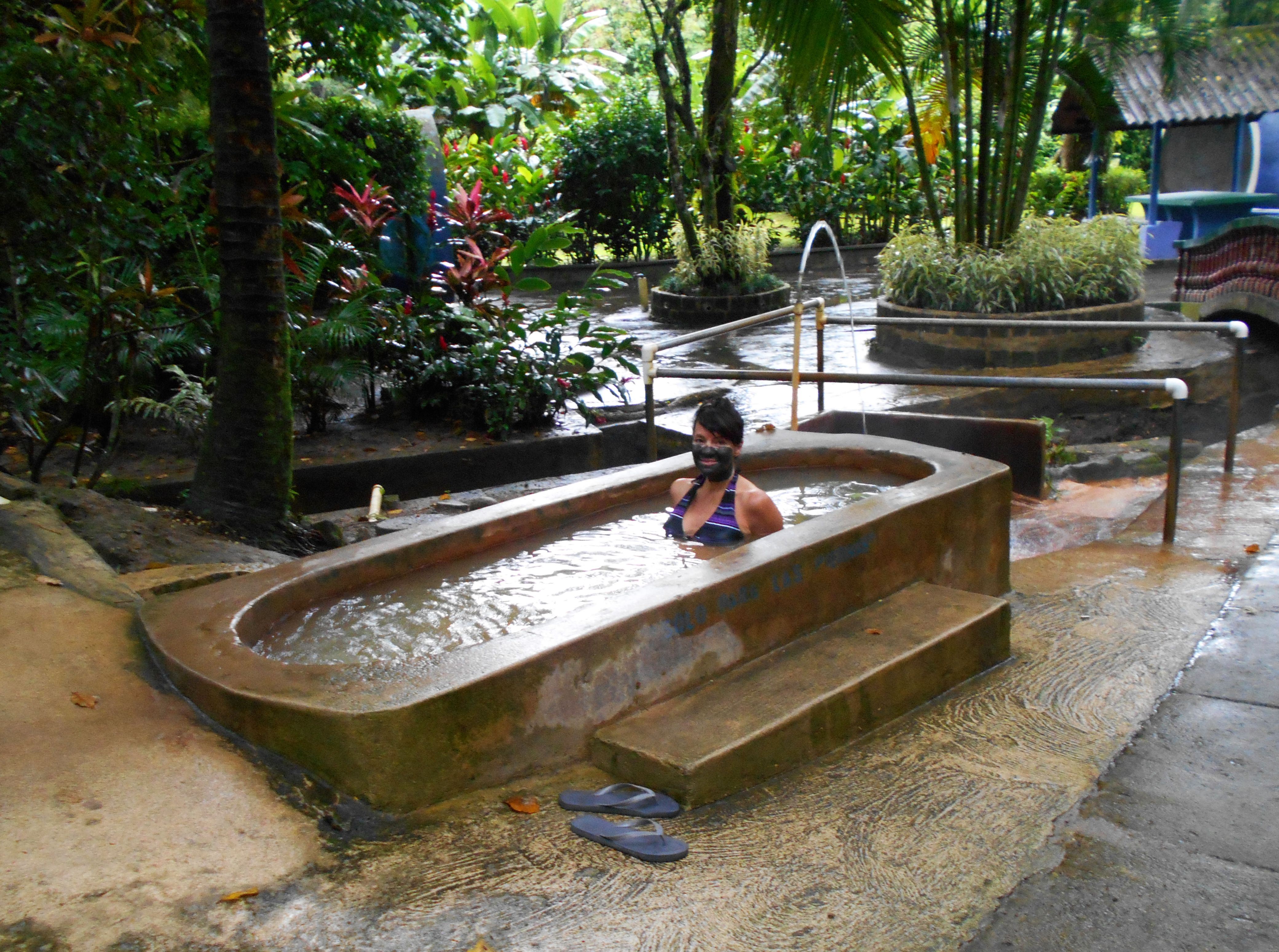
Relaxing in the hot springs. Looking funny with a barro (It. fango) mud mask, but feeling great!
Finally we headed back to main part of town, passing a few more interesting and typical sights in this lovely mountain valley of Valle de Anton…
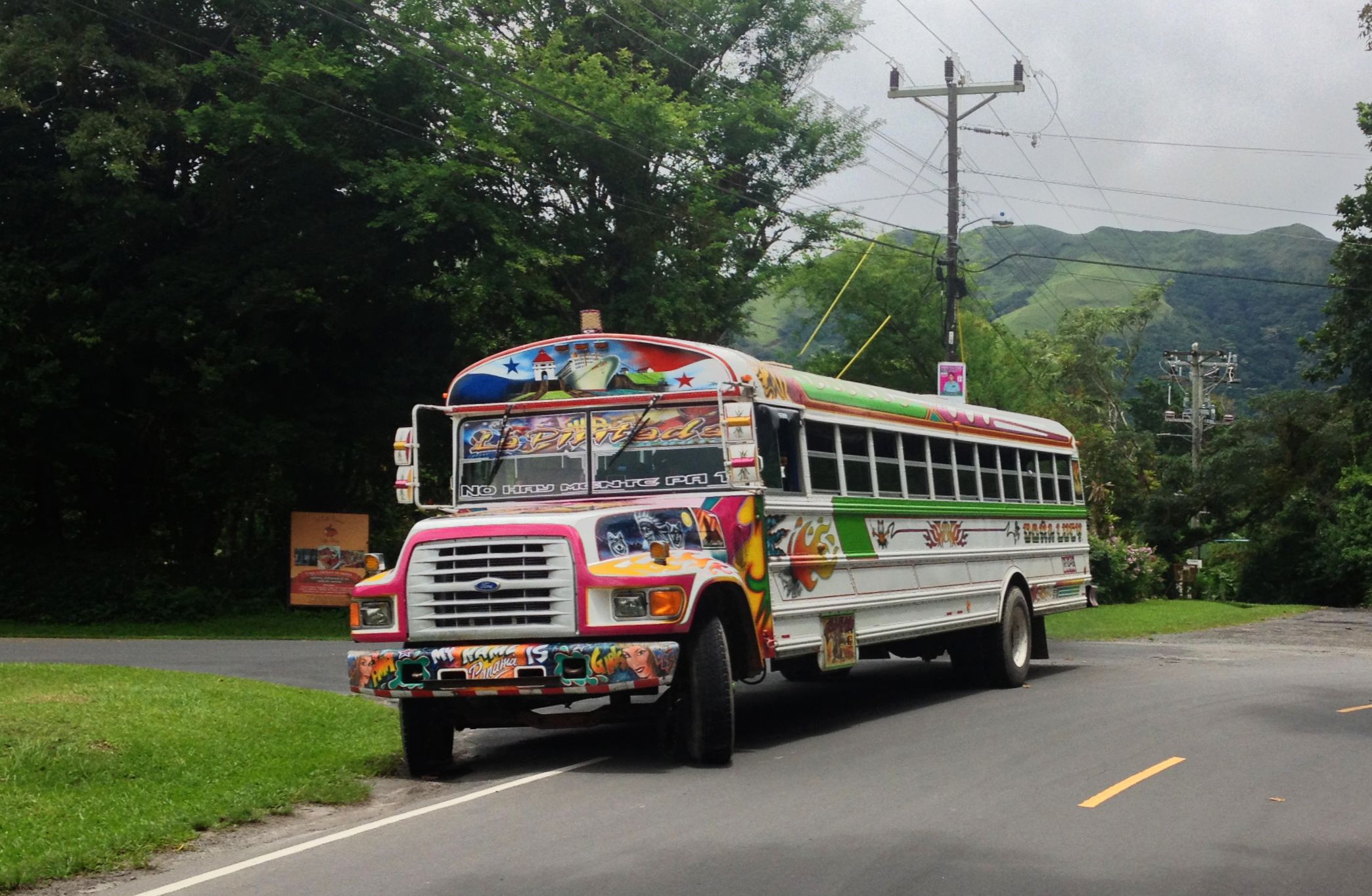
Uno de los autobuses publicos pintados. / One of the painted public buses.
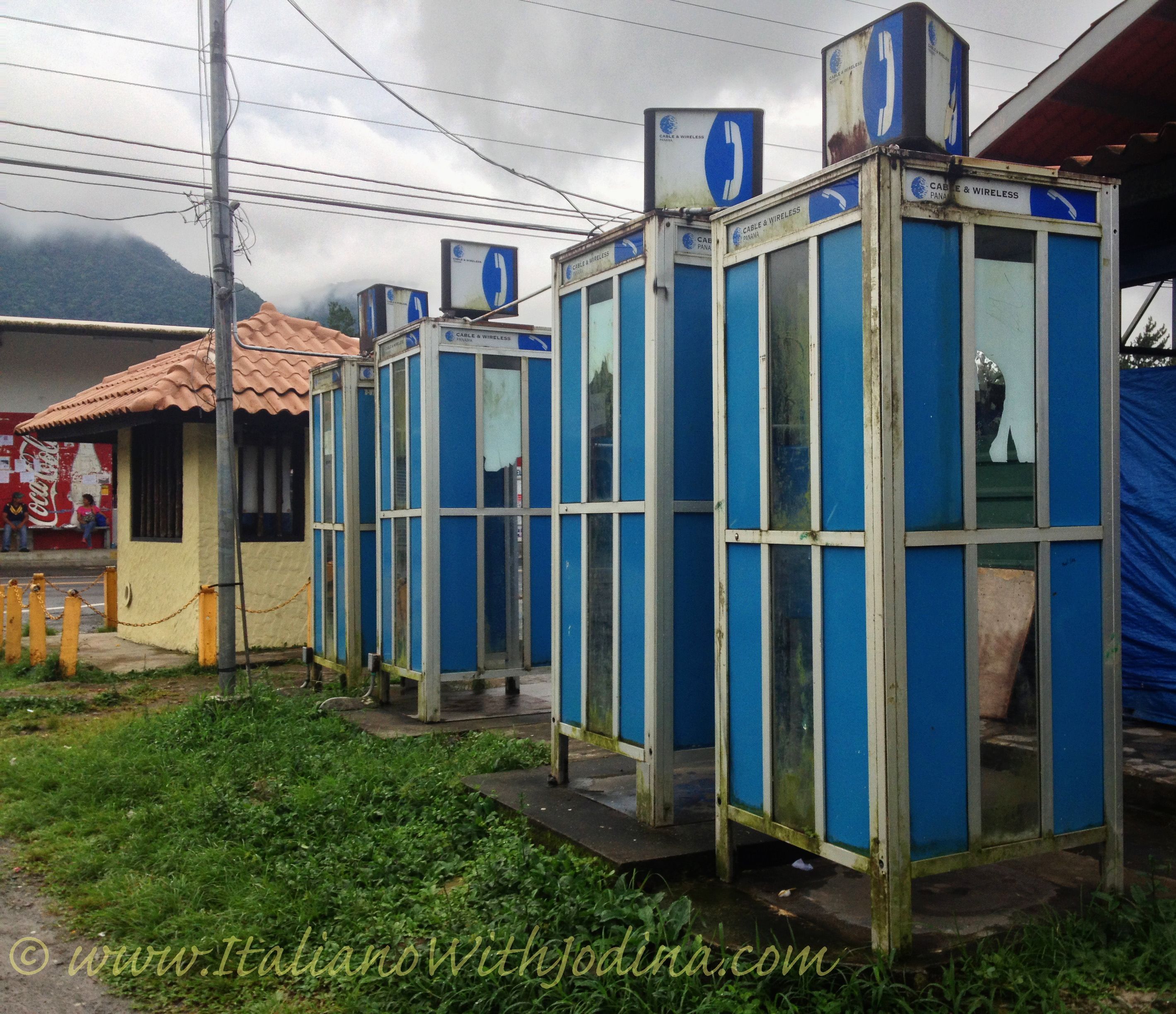
Still-functioning cabinas telefonicas (phone booths), standing like dinosaurs, even though every other person here seems to have a cell phone to their ear.
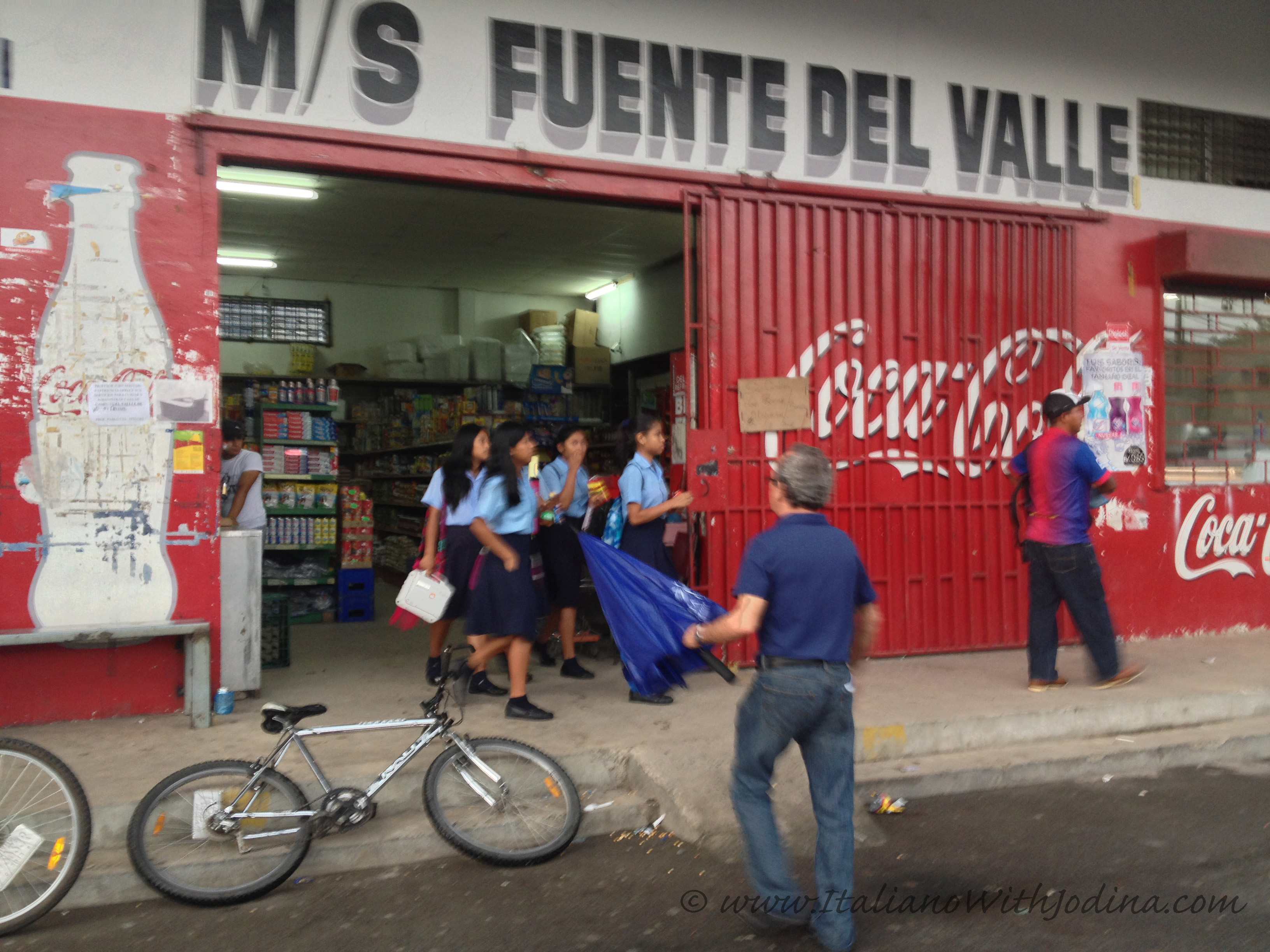
The mini mart/convenience store M/S (short for Mini Supermercacdo) Fuente del Valle, an important town hub on the Avenida Principal (Main Street).
But the most emblematic shot of the Valle de Anton is this one:
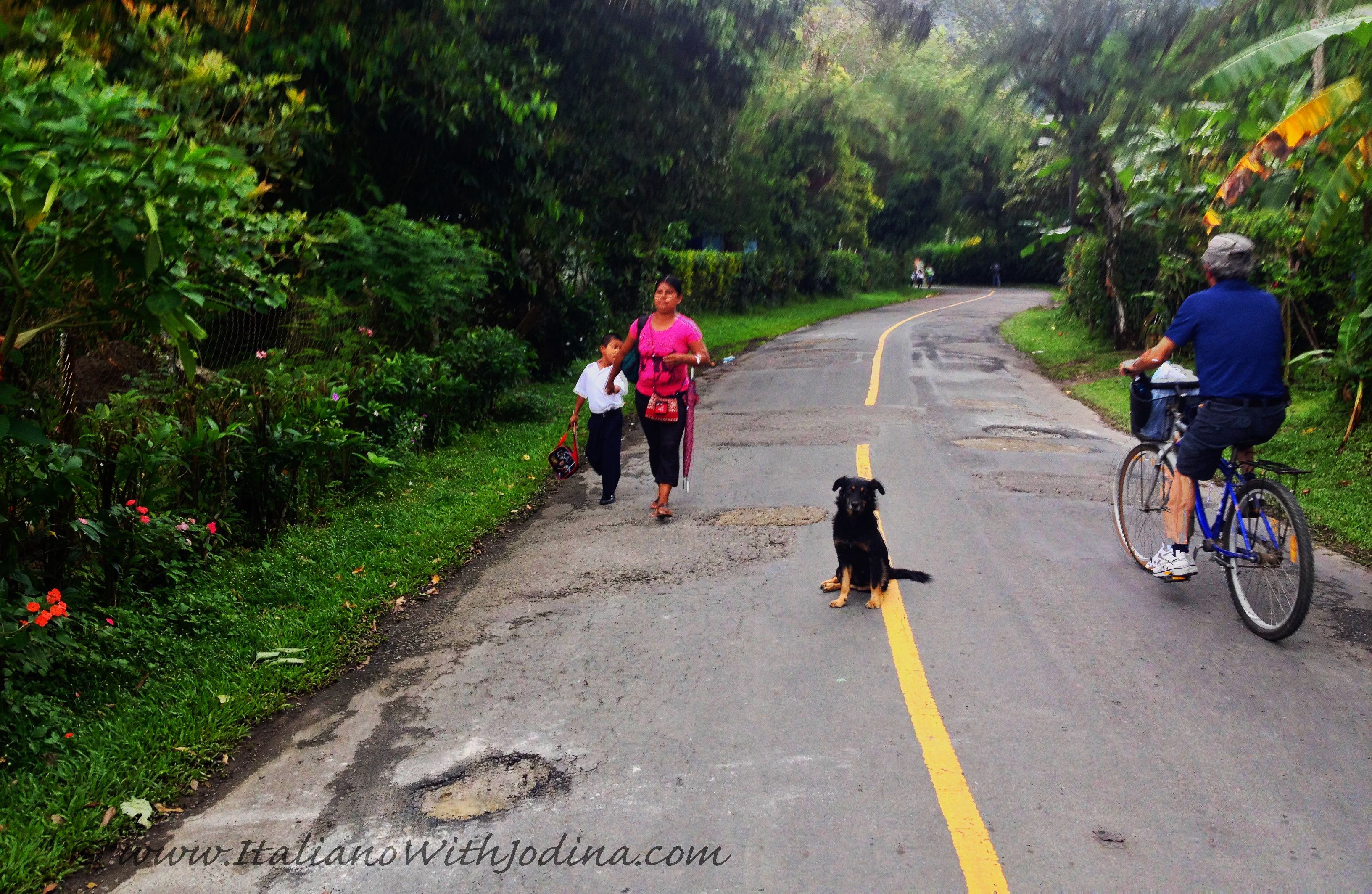
A mom walking her child to school, a bicyclist, and a dog resting right in the middle… all sharing the road… just another peaceful day in Valle de Anton, Panama.
Have you been to Valle de Anton or anywhere like it? Which of these pics is your favorite shot? Love reading your comments!